China Postpones Chang’e-7 Lunar Mission
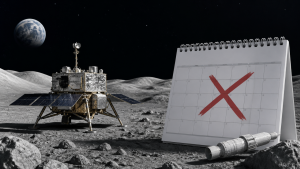
The China Manned Space Agency postponed the Chang’e-7 robotic lunar mission on 23 August 2026 after a comprehensive assessment found that the probe did not meet launch criteria for the planned window. Chang’e-7 is a Chinese lunar exploration mission linked to the search for water ice in permanently shadowed craters near the lunar south pole.
Chang’e Programme
The Chang’e programme is China’s lunar exploration programme named after Chang’e, the moon goddess in Chinese mythology. The programme has included orbiters, landers, rovers, and sample-return missions, and it forms part of China’s broader deep-space exploration effort.
Mission Configuration and Payloads
Chang’e-7 is designed as a multi-component robotic mission with an orbiter, a lander, a rover, and a hopping robot. The mission plan includes scientific instruments for studying lunar surface conditions, volatile materials, and the distribution of water ice in permanently shadowed regions.
The National Astronomical Research Institute of Thailand has a cosmic radiation-detecting payload called CE-7 MATCH on the mission. The payload remains installed on the Chinese orbiter and is not affected by the postponement.
Launch Site and Vehicle
The Chang’e-7 probe and the Long March 5 Y14 carrier rocket were vertically transferred to the launchpad at the Wenchang Spacecraft Launch Site in Hainan Province on 19 August 2026. Wenchang is China’s coastal spaceport used for large launch vehicles, including the Long March 5 series.
The Long March 5 is China’s heavy-lift launch vehicle family, and the Y14 designation identifies a specific rocket unit in the series. The Wenchang site has also handled missions involving communications satellites and lunar exploration hardware.
Important Facts for Exams
- Shackleton Crater lies near the lunar south pole and is one of the best-known sites associated with permanently shadowed regions.
- Water ice on the Moon is studied because it can support future lunar science and in-situ resource use.
- The Long March rocket family is China’s main launch vehicle series for space missions.
- Thailand’s National Astronomical Research Institute has participated in Chinese lunar missions through scientific payloads.
Lunar South Pole Constraints
The lunar south pole has strict orbital and lighting constraints because spacecraft must align with the Sun and the target landing zone. These constraints can limit launch opportunities to one or two windows in a year for missions aimed at polar regions.
Recent Launch Context
The postponement came less than two weeks after a Long March 7A launch anomaly at Wenchang on 12 August 2026 involving the Zhongxing-4B communications satellite. Launch-site weather conditions in the Gulf of Tonkin were also linked to the delay in regional reports.
| Related | |
|---|---|