Centre Proposes Rules for Two-Wheeled Ambulances
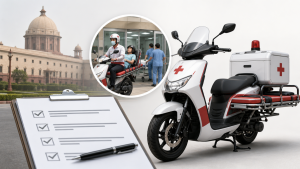
The Ministry of Road Transport and Highways has proposed draft rules to introduce two-wheeled ambulances in India. The draft framework seeks to create a separate legal and technical basis for registration, design, safety, and operation under the Central Motor Vehicles Rules, 1989.
Legal Status Under Motor Vehicle Rules
Two-wheeled ambulances are not currently recognised as a separate vehicle category under the Central Motor Vehicles Rules, 1989. The proposed amendments aim to place them within a defined regulatory structure for emergency medical transport.
Technical Standard and Compliance
The draft rules propose adoption of Automotive Industry Standard (AIS)-209 (Part 1):2026 for life support two-wheeled road ambulances. All L2-category two-wheeled road ambulances manufactured on or after 1 October 2027 must comply with this standard, including requirements for emergency top lights.
Registration, Fitness, and Operation
These vehicles will be registered as transport vehicles under the proposed framework. They will also require mandatory fitness certification, with renewal every two years. State governments will have the power to decide the operational areas for these ambulances on the basis of local requirements and geographic conditions.
Important Facts for Exams
- The Central Motor Vehicles Rules, 1989, provide the legal framework for vehicle classification and regulation in India.
- AIS standards are technical specifications used in India for vehicle construction and safety requirements.
- Transport vehicles in India are subject to registration and periodic fitness certification under motor vehicle law.
- Two-wheeled ambulances are intended for emergency access in remote, rural, hilly, and congested areas.
Emergency Medical Access
Two-wheeled ambulances are designed for faster emergency medical response in areas where larger ambulances face access constraints. The proposed framework links them with last-mile healthcare access and emergency transport services.
| Related | |
|---|---|