Asian Games: History, Editions and Important Facts
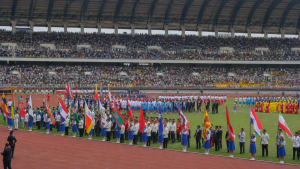
The Asian Games, or Asiad, is a continental multi-sport event held every four years for athletes from across Asia. Recognised by the International Olympic Committee (IOC), it is the world’s second-largest multi-sport event after the Olympic Games.
Origin and Evolution
The idea for the Asian Games was proposed by Indian representative Guru Dutt Sondhi during the 1948 London Olympics. The Asian Athletic Federation, a precursor to the body that would organise the Games, was formally inaugurated in New Delhi on February 13, 1949. The Games were inspired by the Olympic movement and followed the Far Eastern Championship Games, held from 1913 to 1934. The first Asian Games took place in New Delhi from March 4 to 11, 1951. The event’s motto, “Ever Onward,” was proposed by Sondhi. Its official emblem features a bright red sun with 16 rays and a white circle at the centre.
Governance and Significance
The Asian Games Federation (AGF) regulated the event from the inaugural Games in 1951 through the 1978 edition. The Olympic Council of Asia (OCA) replaced the AGF in 1982 and has organised the Games since that year. The OCA is headquartered in Kuwait City. As a regional sporting forum, the Games bring athletes and teams from across Asia together in a shared competition. They support sports development and provide participating countries with a platform for international representation. The programme combines internationally recognised sports with events that have strong cultural roots in Asia.
Editions and Hosts
The 2026 Asian Games, also known as Aichi-Nagoya 2026, are scheduled to be held in Aichi Prefecture and Nagoya, Japan, from September 19 to October 4. This will be the 20th edition. The programme is scheduled to include 43 sports, 71 disciplines and 469 events. Doha, Qatar, is planned to host the 2030 Games, followed by Riyadh, Saudi Arabia, in 2034. Nine distinct nations have hosted the Asian Games. Thailand has hosted the event four times, the most of any nation. The first edition drew 489 athletes representing 11 National Olympic Committees. Across the history of the Games, 46 nations have participated. The 2026 edition is expected to involve more than 11,000 athletes and 6,000 officials representing 45 countries and regions.
Sports and Participation
The 1951 Games featured six main sports: athletics, aquatics, basketball, cycling, association football and weightlifting. The programme has since included a broad mix of sports, including Kabaddi, Sepak Takraw, Wushu and Kurash, which have strong cultural connections in Asia. Kabaddi was a demonstration sport at the 1951 and 1982 Games before becoming a medal sport in 1990 at the Beijing Asian Games. Women’s kabaddi joined the programme in 2010. These milestones reflect the inclusion of sports with regional roots alongside established international events. Esports became an official medal sport at the Hangzhou Asian Games in 2023. Virtual Taekwondo has been added to the programme for 2026. Together, these changes show how the sports programme can incorporate newer disciplines while retaining events associated with Asian sporting traditions.
Medal Records and Other Facts
China ranks first in the overall medal table across Asian Games editions. India is fifth by total medals and, along with Japan, has won gold medals at every summer edition of the Games. India’s best-ever medal haul was 107 at the Hangzhou 2022 Asian Games, held in 2023. Israel competed at the Games until its last appearance in 1974 and was subsequently excluded. The Games’ history and participation record therefore offer useful context for questions on host nations, sporting milestones and the representation of countries in continental competitions.
Key Prelims Takeaways
- Originator and motto: Guru Dutt Sondhi proposed the Games and the motto “Ever Onward”.
- First edition: New Delhi, India, March 4–11, 1951.
- Governing body: The OCA has organised the Games since 1982; its headquarters are in Kuwait City.
- Most frequent host: Thailand, with four editions.
- Kabaddi milestones: Medal sport from 1990; women’s kabaddi introduced in 2010.
- Recent programme milestones: Esports became a medal sport in 2023; Virtual Taekwondo is included for 2026.
- Upcoming hosts: Aichi-Nagoya in 2026, Doha in 2030 and Riyadh in 2034.
Recent Context
The inaugural Commonwealth Kabaddi Championship is being held in Ahmedabad from October 23 to 31, 2026, at Veer Savarkar Sports Complex. It features 23 squads from 13 nations and aims to support Kabaddi’s potential inclusion in the 2030 Commonwealth Games.
| Related | |
|---|---|