Major Joint Military Exercises Between India and Central Asian Countries
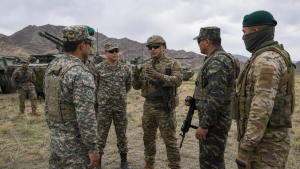
India’s military exercises with Uzbekistan and Kazakhstan strengthen defence diplomacy, interoperability and capacity building in Central Asia. DUSTLIK and KAZIND focus on counter-terrorism, while multilateral cooperation supports regional stability and coordinated responses to shared security concerns.
Strategic Significance of Defence Cooperation
Central Asia is important to India for its location, energy resources and role in regional connectivity. India’s defence engagement with countries including Uzbekistan and Kazakhstan reflects shared concerns about terrorism, extremism and drug trafficking, as well as the need to build capacities and exchange best practices. Instability in Afghanistan has heightened the importance of cooperation on cross-border security threats. Joint exercises provide a practical setting for military personnel to plan and operate together, while also supporting wider diplomatic engagement.
- Defence diplomacy: Regular exercises sustain bilateral engagement and deepen cooperation between India and its Central Asian partners.
- Interoperability: Joint planning and tactical drills help participating forces coordinate their capabilities in shared operational scenarios.
- Regional stability: Capacity building and counter-terrorism cooperation contribute to responses to security challenges affecting the wider region.
DUSTLIK: India–Uzbekistan Exercise
DUSTLIK is an annual bilateral military exercise between India and Uzbekistan, conducted alternately in the two countries. It aims to improve military cooperation and the ability to conduct joint counter-terrorism operations, particularly in semi-mountainous terrain. Training includes physical fitness, joint planning, tactical drills and special arms skills. The 7th edition, DUSTLIK 2026, took place from April 12 to 25 at the Gurumsaray Field Training Area in Namangan, Uzbekistan.
- Indian contingent: It comprised 60 personnel, including 45 from the Indian Army, primarily from a battalion of the MAHAR Regiment, and 15 from the Indian Air Force. Uzbekistan fielded a similar strength.
- Operational focus: Training included joint special operations to neutralise unlawful armed groups and improve operational synergy.
- Technology: The exercise included the integration of niche technologies and drone-based surveillance.
- Previous edition: DUSTLIK 2025 was held at the Foreign Training Node in Aundh, Pune, India.
India and Uzbekistan elevated their bilateral relationship to a Comprehensive Strategic Partnership in August 2026. The partnership includes cooperation in defence, counter-terrorism and cybersecurity, placing the exercise within a broader framework of bilateral engagement.
KAZIND: India–Kazakhstan Exercise
KAZIND is a bilateral military exercise between India and Kazakhstan. It develops interoperability and joint capabilities for counter-terrorism operations in a sub-conventional environment under a United Nations mandate. The 9th edition, KAZIND 2026, was conducted in Oskemen, Kazakhstan, from September 28 to October 11.
- Participants: India contributed a 60-member Armed Forces contingent, primarily from a battalion of the Garhwal Rifles, along with Indian Air Force personnel. Kazakhstan fielded a similar-strength contingent from its Land Forces.
- Terrain: Training focused on operations in semi-urban and mountainous areas.
- Counter-terrorism drills: Activities included responses to terrorist attacks, raids, search-and-destroy missions, and cordon-and-search operations.
- Joint capabilities: The exercise included joint planning, air mobility, and the integrated use of unmanned aerial systems and counter-UAS capabilities.
Multilateral Counter-Terrorism Cooperation
India and Central Asian countries also cooperate through multilateral institutions and mechanisms, including the United Nations, the Shanghai Cooperation Organisation’s Regional Anti-Terrorist Structure (SCO-RATS), and the Eurasian Group on combating money laundering and terrorism financing.
- Shanghai Cooperation Organisation: Established in 2001, the SCO is a Eurasian political, economic and international security organisation. India became a full member in 2017.
- SCO-RATS: This permanent SCO body coordinates cooperation among member states against terrorism, separatism and extremism. It is based in Tashkent, Uzbekistan.
- Eurasian Group: Established in 2004, the EAG is a Financial Action Task Force-style regional body addressing money laundering and the financing of terrorism. India is a member.
- Purpose: The EAG seeks to reduce the threat of international terrorism by supporting transparency and security in member states’ financial systems.
Key Prelims Takeaways
- DUSTLIK: India–Uzbekistan exercise; its 7th edition was held in Namangan in April 2026.
- KAZIND: India–Kazakhstan exercise; its 9th edition was held in Oskemen in September–October 2026.
- Exercise pattern: DUSTLIK is annual and alternates between India and Uzbekistan.
- KAZIND mandate: It develops counter-terrorism capabilities under a United Nations mandate.
- SCO: Established in 2001; India became a full member in 2017.
- Regional bodies: SCO-RATS is based in Tashkent; the EAG is an FATF-style body established in 2004.
Recent Context
On October 22, 2026, India and Uzbekistan held the 10th meeting of their Joint Working Group on Counter Terrorism in New Delhi. They agreed to deepen cooperation through information sharing, capacity building and exchanges of best practices. The next meeting is scheduled to be held in Uzbekistan.
| Related | |
|---|---|