Army Chief Launches Indigenous Xtreme Weather Grade Diesel
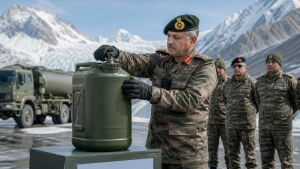
General Dhiraj Seth, the Chief of the Army Staff, launched the indigenously developed Xtreme Weather Grade (XWG) Diesel in New Delhi on 31 July 2026. The fuel has been developed jointly by the Indian Army and Bharat Petroleum Corporation Limited for use in extreme climatic conditions.
Xtreme Weather Grade Diesel: Key Features
XWG Diesel is designed for combat and logistics vehicles operating in severe winter conditions. It functions at temperatures as low as minus 42 degrees Celsius and is intended to improve mobility, safety, and operational availability. The fuel can be used in the Indian Army’s existing vehicle fleet without modifications. It complies with BS-VI standards and IS 1460:2025 specifications.
Operational and Technical Context
Conventional diesel thickens in very low temperatures and can clog fuel filters. Such conditions have earlier created difficulties in vehicle operation in high-altitude and cold regions. XWG Diesel addresses these issues through a fuel formulation suited to extreme weather use. The Army has linked the fuel with improved mission reliability in cold terrain.
Development and Supply Chain
Bharat Petroleum Corporation Limited has established a supply chain for XWG Diesel from its Bina Refinery to strategic storage at Bathinda. The arrangement is intended to support timely availability at forward locations. The fuel was developed under a collaboration between the Indian Army and oil marketing companies. Its wider civilian use is relevant for high-altitude and severe winter regions.
Important Facts for Exams
- BS-VI refers to Bharat Stage VI emission norms used in India for vehicular fuels and engines.
- IS 1460:2025 is an Indian Standard specification for diesel fuel.
- Atmanirbhar Bharat is a Government of India initiative associated with self-reliance in manufacturing and technology.
- Bathinda is a major military and logistics location in Punjab.
Military Fuel in Extreme Weather
Specialised fuels are used in cold regions to maintain engine performance at low temperatures. Such fuels are relevant for military logistics in high-altitude areas and winter deployments.
| Related | |
|---|---|