16th National Meet of Biodiversity Boards Held in Chandigarh
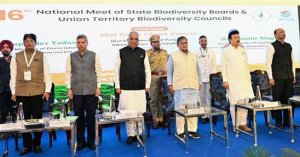
The 16th National Meet of State Biodiversity Boards and Union Territory Biodiversity Councils was held in Chandigarh on 6–7 September 2026. The two-day meeting was organised by the National Biodiversity Authority to discuss biodiversity governance, local implementation, and conservation-related institutional mechanisms in India.
National Biodiversity Governance Framework
The National Biodiversity Authority is a statutory body under the Biological Diversity Act, 2002. State Biodiversity Boards function at the state level, while Union Territory Biodiversity Councils operate in Union Territories for biodiversity management and regulation.
These institutions are linked to the three-tier biodiversity governance structure in India, which also includes Biodiversity Management Committees at the local body level. The framework covers conservation, sustainable use, and access and benefit sharing related to biological resources.
Biological Diversity Act and Rules
The Biological Diversity (Amendment) Act, 2023, and the Biological Diversity Rules, 2024, form the current legal framework for biodiversity governance in India. The amended law and rules are relevant for access to biological resources, benefit sharing, and compliance mechanisms.
India is a Party to the Convention on Biological Diversity, which was adopted in 1992 and entered into force in 1993. India is also a Party to the Nagoya Protocol on Access and Benefit Sharing, which was adopted in 2010.
Local Institutions and Biodiversity Records
India has over 2.76 lakh Biodiversity Management Committees at the local level. These committees prepare People’s Biodiversity Registers, which record local biological resources, traditional knowledge, and associated community practices.
People’s Biodiversity Registers are used as local documentation tools under the biodiversity law. Biodiversity Management Committees are constituted by local bodies such as panchayats, municipalities, and municipal corporations.
Important Facts for Exams
- The National Biodiversity Authority was established under the Biological Diversity Act, 2002.
- The Convention on Biological Diversity has three main objectives: conservation, sustainable use, and fair and equitable benefit sharing.
- The Nagoya Protocol deals with access to genetic resources and benefit sharing.
- People’s Biodiversity Registers are prepared at the local body level in India.
International Reporting and Conservation Agenda
India submitted its 7th National Report to the Convention on Biological Diversity and its 1st National Report on the Nagoya Protocol. These reports are part of international compliance under multilateral environmental agreements.
The Chandigarh meeting concluded on 7 September 2026 with discussions on Access and Benefit Sharing, capacity building, and ecosystem conservation.
| Related | |
|---|---|