Why Faecal Sludge Management Is the Next Big Test for Swachh Bharat’s Rural Success

When the “Swachh Bharat Mission (SBM)” was launched in 2014, its promise was clear and ambitious: end open defecation in India. A decade later, that promise has largely been fulfilled. Over 12 crore household toilets have been constructed in rural areas, and every village has declared itself Open Defecation Free (ODF). Few public programmes have delivered such visible gains in public health, dignity, and social equity. But success has also revealed a harder, less visible challenge — what happens after the toilet is built.
From toilets to systems: why sanitation does not end at construction
Toilets are only the first step in the sanitation chain. Most rural households depend on septic tanks or pits, which inevitably fill up and require periodic desludging. In the absence of organised systems for collection, transport, and treatment of faecal sludge, waste is often dumped untreated into fields, drains, or water bodies — undoing health and environmental gains achieved under ODF.
This recognition underpins Phase II of the “Swachh Bharat Mission (Grameen)”, which focuses on ODF Plus. The objective is sustainability: solid and liquid waste management, safe sanitation service chains, and long-term behavioural change.
ODF Plus: impressive coverage, uneven depth
Progress on ODF Plus has been rapid on paper. By October 2025, over 5.68 lakh villages — nearly 97% of India’s total — had been declared ODF Plus. Yet faecal sludge management (FSM) remains one of the weakest links, particularly in peri-urban and rural areas where population density is rising but infrastructure is limited.
Without structured desludging services and treatment facilities, households are forced to rely on informal operators charging high rates and disposing of waste unsafely. This gap poses both a public health risk and a governance challenge.
Maharashtra’s early lead in faecal sludge treatment
Maharashtra has emerged as a frontrunner in addressing this challenge. The State has invested in more than 200 faecal sludge treatment plants (FSTPs) in urban areas and enabled co-treatment in 41 sewage treatment plants. These facilities provide a robust treatment backbone for cities — but their full potential lies in serving the villages that surround them.
The question has been how to bridge the administrative and operational divide between urban infrastructure and rural sanitation needs.
Satara’s urban–rural partnership model
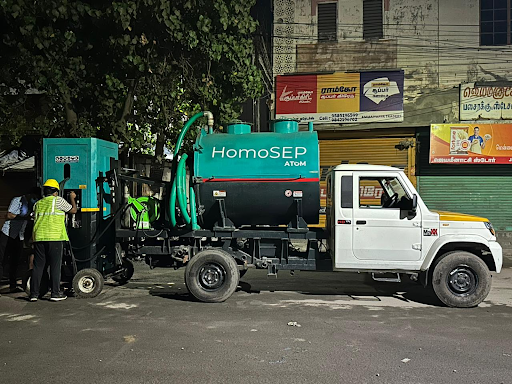
Satara district offers a practical answer. The city’s faecal sludge treatment plant, with a capacity of 65 kilo litres per day, was operating below capacity. Four nearby villages — Jakatwadi, Songaon, Kodoli and Degaon — were integrated into a formal arrangement allowing them to access this urban facility.
Under the model, gram panchayats contract a private service provider to carry out scheduled desludging every five years. Costs are recovered through a modest sanitation tax, keeping services affordable while ensuring accountability. A formal agreement between the Satara Panchayat Samiti and the Municipal Council allows authorised rural desludging vehicles to use the city plant at no treatment cost — creating a mutually beneficial system.
When cities are not nearby: the case for rural clusters
Urban linkages are not always possible. In villages like Mayani in Khatav taluka, the solution lies in scale and clustering. Faced with high desludging demand, the gram panchayat has committed to scheduled desludging every five to seven years, managed by private operators or self-help groups.
More significantly, Mayani has been selected for a cluster-level faecal sludge treatment plant under SBM-G, designed to serve around 80 surrounding villages. Pooling demand makes standalone rural treatment infrastructure financially and technically viable — an approach that could be replicated across districts with dispersed settlements.


Why faecal sludge management is central to rural sustainability
These pilots underline a larger lesson: sustaining ODF outcomes requires systems, not just assets. Effective FSM depends on coordination between urban and rural governments, private operators, community institutions, and citizens. It also demands predictable financing, clear contracts, and regulatory oversight.
Importantly, FSM brings sanitation back into the realm of dignity and health — the core values that animated Swachh Bharat in the first place.
A model that can travel beyond Maharashtra
If scaled up, Satara’s dual approach — urban-rural linkages where possible and cluster-based treatment where not — could reshape rural sanitation across India. The real success of Swachh Bharat will ultimately be measured not by the number of toilets built, but by the invisible systems that keep them safe, functional, and environmentally sound.
In that sense, faecal sludge management is not a technical add-on. It is the next defining test of India’s sanitation revolution — one that will determine whether today’s gains endure for generations to come.
| Related | |
|---|---|