Lycodon Jara
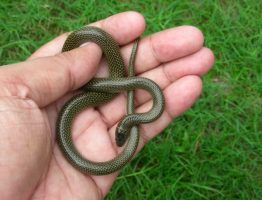
Lycodon jara, commonly known as the twin-spotted wolf snake, is a small, non-venomous species of colubrid snake belonging to the family Colubridae. It is a member of the genus Lycodon, a group of Asian snakes characterised by specialised dentition and generally secretive habits. Lycodon jara is of particular interest for its distinctive dorsal pattern of paired pale markings, compact body size, and its distribution across parts of eastern and northern South Asia. Although harmless to humans, it is rarely encountered due to its nocturnal and cryptic lifestyle.
Taxonomy and Systematic Position
The species was formally described in the nineteenth century and subsequently treated in detail by George Albert Boulenger in The Fauna of British India, Including Ceylon and Burma (1890) and later in the Catalogue of the Snakes in the British Museum (Natural History) (1893). These classical works established the diagnostic scalation and morphological characters that continue to define the species.
Within the genus Lycodon, L. jara is distinguished by its small size, smooth dorsal scalation, and the presence of paired pale spots or short streaks on each dorsal scale. The species has remained taxonomically stable, with no major synonymy disputes compared with some other wolf snakes.
Geographic Distribution
Lycodon jara is endemic to Asia, with a distribution centred in South Asia, particularly the eastern and north-eastern parts of the Indian subcontinent. It is known to occur in:
- Bangladesh
- India, including the states of Assam, Odisha, Arunachal Pradesh, Manipur, West Bengal, and parts of Uttar Pradesh
- Nepal
This distribution places the species primarily within the Indo-Gangetic plains, the eastern Himalayan foothills, and adjoining forested and semi-forested regions. Its presence across both lowland and submontane areas suggests a degree of ecological flexibility within suitable habitats.
Habitat and Environmental Preferences
The twin-spotted wolf snake is associated with terrestrial habitats that provide ample ground cover. Although detailed ecological studies are lacking, it is generally found in:
- Forested areas and forest edges
- Shrubland and secondary vegetation
- Leaf-litter-rich ground near water bodies or moist soil
Like other members of the genus, Lycodon jara is believed to be nocturnal, remaining concealed during the day under stones, logs, or dense vegetation. Its small size and secretive behaviour contribute to its infrequent detection, even in areas where it is locally present.
General Morphology and Size
Lycodon jara is a small-bodied snake, with adults reaching a total length of approximately 35 cm, including a tail of about 6 cm. Its slender form allows it to move efficiently through leaf litter and narrow crevices in search of prey.
The snout is much depressed, and the eyes are relatively small, features commonly associated with nocturnal and semi-fossorial habits. The head is not strongly distinct from the neck, giving the snake a streamlined appearance well suited to its cryptic lifestyle.
Head Scalation and Diagnostic Characters
The head scalation of Lycodon jara provides several important diagnostic features:
- The rostral scale is much broader than long and is just visible from above.
- The internasal scales are much shorter than the prefrontals.
- The frontal scale is as long as or slightly shorter than its distance from the tip of the snout and is a little shorter than the parietals.
- The loreal scale is elongate and does not enter the eye.
- There is one preocular and two postoculars.
- The temporals are small and arranged in a 1 + 2 pattern.
- There are nine or ten upper labial scales, with the third, fourth, and fifth entering the eye.
- Four or five lower labials are in contact with the anterior chin shields, which are longer than the posterior chin shields.
These characters, taken together, distinguish L. jara from other small wolf snakes occurring within its range.
Body Scalation
The body scalation of Lycodon jara is consistent with its placement in the genus:
- Dorsal scales are smooth and arranged in 17 rows at midbody.
- Ventral scales number between 167 and 175 and are not angulate laterally.
- The anal scale is divided.
- Subcaudal scales are divided and number 56 to 63, arranged in two rows.
The smooth dorsal scales facilitate movement through leaf litter and reduce resistance when the snake enters narrow shelters.
Colouration and Pattern
The common name twin-spotted wolf snake derives from the species’ distinctive dorsal pattern. In preserved specimens, the dorsal surface is described as brown, with each dorsal scale bearing two white dots or short longitudinal white lines. These paired markings create a subtle but characteristic pattern across the body.
The labial scales are white, and there is usually a white collar present behind the head, although this may be faint or incomplete in some individuals. The lower surface of the body is uniformly white, lacking additional markings.
While colouration in live specimens may differ slightly from that observed in preserved material, the paired dorsal spots remain a defining feature and assist in field identification.
Behaviour and Activity Patterns
Although specific behavioural observations of Lycodon jara are scarce, it is inferred to share behavioural traits common to other wolf snakes. These include nocturnal activity, reliance on camouflage and concealment, and a tendency to avoid open ground during daylight hours.
When disturbed, the species is likely to attempt escape rather than display aggressive behaviour. As a non-venomous snake, it poses no threat to humans, though it may bite defensively if handled. Any such bites are superficial and result from sharp teeth rather than venom.
Diet and Feeding Ecology
Direct data on the diet of Lycodon jara are not available. However, based on the feeding habits of closely related species, it is presumed to feed primarily on small reptiles, particularly lizards such as skinks and geckos. Small amphibians may also be taken opportunistically.
Wolf snakes possess enlarged anterior teeth, which are adapted for gripping smooth-bodied prey. This dentition allows them to hold and subdue agile prey items that might otherwise escape.
Reproductive Biology
The reproductive biology of Lycodon jara has not been studied in detail. By analogy with other members of the genus, it is assumed to be oviparous, laying eggs rather than giving birth to live young. Information on clutch size, breeding season, and incubation period remains unknown.
Reproductive activity is likely seasonal, coinciding with warmer and wetter periods that favour both egg development and prey abundance.
Conservation and Scientific Significance
Lycodon jara has not been the subject of a dedicated conservation assessment, and its population status remains poorly understood. Its relatively wide but patchy distribution suggests that it is not immediately threatened at a global scale, though habitat loss, deforestation, and agricultural expansion may pose localised risks.
Scientifically, the species is significant as a representative of small-bodied wolf snakes in South Asia. Its detailed early descriptions by Boulenger continue to serve as a reference point for taxonomic and comparative studies within the genus Lycodon. The twin-spotted wolf snake contributes to understanding patterns of morphological variation, habitat use, and biogeography among Asian colubrids.