Lake Zurich
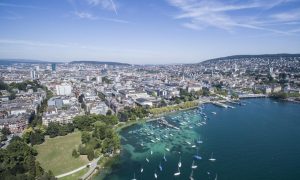
Lake Zurich is a prominent lake in Switzerland extending southeast of the city of Zurich. Its name may refer either to the entire lake system or only to the section downstream of the Hurden Peninsula and the Seedamm causeway between Pfäffikon (Schwyz) and Rapperswil. In such cases, the upstream section is known as the Obersee (Upper Lake Zurich), while the downstream section is sometimes referred to as the Lower Lake.
Geographical Setting
Lake Zurich is a classic glacial lake formed during the last Ice Age. Its primary inflow is the River Linth, which originates in the glaciers of the Glarus Alps. Historically, the Linth flowed directly into the lake, but early nineteenth-century engineering works rerouted it. The construction of the Escher canal (1811) diverted the river into Lake Walen, and the completion of the Linth canal (1816) directed its waters into the eastern extremity of Lake Zurich near Schmerikon.
Prior to the sixteenth century, a smaller neighbouring lake—Tuggenersee—existed upstream of the Obersee, but it has since disappeared through natural changes and land development. The water of Lake Zurich flows out at Zurich’s Quaibrücke and continues through the city as the Limmat River, which later joins the Aare and subsequently the High Rhine.
Tributaries include the Jona, Schmerikoner Aa, Steinenbach and the outflow from Wägitalersee, in addition to numerous small creeks entering the Obersee. The highest point of the lake’s drainage basin is the Tödi massif at 3,614 metres above sea level.
Physical Features and Landscape
At its narrowest point, the lake is crossed by the Seedamm, an artificial causeway linking Rapperswil and Pfäffikon. This structure carries both a railway and road, and is accompanied by the historic Holzbrücke (Rapperswil–Hurden wooden footbridge). West of the Seedamm lie the islands of Lützelau and Ufenau, noted for their historical heritage; Ulrich von Hutten famously sought refuge on Ufenau in 1523.
Smaller islands such as Grosser Hafner, Saffa-Insel and Schönenwerd are located nearer the Zurich shoreline. The Au Peninsula, situated between Wädenswil and Horgen, is a popular cultural and recreational area.
The lake shores are heavily cultivated and include protected natural areas such as Frauenwinkel and Bätzimatt. Wetlands near Rapperswil and Nuolen serve as winter habitats for numerous bird species. To the east, the smaller lakes Greifensee and Pfäffikersee are separated from Lake Zurich by a series of hills including the Zürichberg, Adlisberg, Forch and Pfannenstiel. To the west and south stand Zimmerberg, Etzel and Buechberg, with the higher peaks of Speer, Chemettler and Federispitz visible from the southern lakeshore.
Administratively, Lake Zurich spans several cantons: the lower lake lies predominantly within the Canton of Zurich, whereas the Obersee is shared between the Cantons of St Gallen and Schwyz.
Tributaries of the Lower Lake
Numerous small rivers and streams enter the lower lake from both shores. Notable examples, listed clockwise from the outflow of the Limmat, include the Hornbach at Zürichhorn, Küsenbach and Heslibach at Küsnacht, Dorfbach and Schipfbach at Erlenbach, and the Meilener Dorfbach at Meilen. On the opposite shore, tributaries include the Sarenbach at Freienbach, the Mülbach at Richterswil, and the Zürichsee stream at Wädenswil.
Settlements Around the Lake
Zurich, situated at the northwestern end, is the largest settlement on the lake. Other towns and villages along the western and southern shores include Kilchberg, Rüschlikon, Thalwil, Oberrieden, Horgen, Au, Wädenswil and Richterswil in the Canton of Zurich, and Freienbach, Pfäffikon, Hurden, Altendorf, Lachen, Nuolen and Tuggen in the Canton of Schwyz.
On the opposite shore are Zollikon, Küsnacht, Erlenbach, Herrliberg, Feldmeilen, Meilen, Stäfa and Feldbach. Rapperswil-Jona, known for its medieval old town and castle, lies near the Seedamm and includes Kempraten, Busskirch and Bollingen. Further east are Schmerikon and Uznach.
Prehistoric and Historical Context
The shores of Lake Zurich contain significant archaeological remains. Nine prehistoric pile-dwellings form part of the UNESCO World Heritage listing Prehistoric Pile Dwellings around the Alps. These sites include Freienbach-Hurden (Rosshorn and Seefeld), Rapperswil-Hombrechtikon, Rapperswil-Technikum, Erlenbach-Winkel, Meilen-Rorenhaab, Wädenswil-Vorder Au, Zurich-Enge (Alpenquai) and Zurich-Kleiner Hafner. Due to historical changes in water level, the original wooden piles now lie several metres beneath the lake surface.
Additional prehistoric settlements are located nearby, such as Greifensee-Storen-Wildsberg and Wetzikon-Robenhausen. The area of Kempraten was once home to the Gallo-Roman settlement Centum Prata, and present-day Zurich evolved from the Roman settlement Turicum.
Transport and Connectivity
Due to the Seedamm’s strategic location, Rapperswil and Pfäffikon are major transit nodes around the lake alongside Zurich. The lake is crossed only at the Quaibrücke in Zurich and the Seedamm, although the towns of Meilen and Horgen are linked by a roll-on/roll-off ferry.
Road and Bus TransportBus services on the western shore are operated by Zimmerberg Bus, while the eastern shore and nearby highlands are serviced by Verkehrsbetriebe Zürichsee und Oberland (VZO), which also manages bus routes in Rapperswil-Jona. In Zurich, transport includes trams, trolleybuses and city buses.
Rail Network
- Left-bank line: connects Zurich with the southern lakeshore towns, served by multiple Zürich S-Bahn lines and InterRegio trains, and used by long-distance services such as EuroCity and Railjet. It links with the Wädenswil–Einsiedeln line.
- Right-bank line: runs between Zurich Hauptbahnhof and the eastern lower-lake communities, historically known as the “Gold Coast”.
- Rapperswil–Ziegelbrücke line: serves the northern Obersee and connects Rapperswil with communities to the east.
- Seedamm line: links Rapperswil with Pfäffikon, served by S-Bahn routes and the Voralpen-Express.
Lake TransportThe Zürichsee-Schifffahrtsgesellschaft operates passenger ships offering regular and tourist services. The Horgen–Meilen ferry provides a key cross-lake connection for vehicles and passengers.
Freeze Events
The complete freezing of Lake Zurich—known locally as a Seegfrörni—is a rare occurrence. Documented freeze events span from the thirteenth century to 1963, the last year in which the lake fully froze. These events allowed large public festivals and temporary crossings on foot, forming part of the region’s historical memory.
Water Quality and Recreation
The lake is noted for its exceptionally clean water, which often exceeds warm summer temperatures conducive to swimming. Numerous public baths, beaches and lakeside recreational areas attract residents and tourists alike. Lake Zurich also serves as an important source of potable water for the city, after undergoing purification.
| Related | |
|---|---|