TNSDA Uncovers Over 1,000 Artefacts at Vellalore
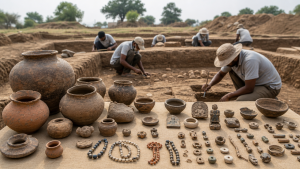
The Tamil Nadu State Department of Archaeology (TNSDA) has unearthed more than 1,000 artefacts from the Noyyal river bed at Vellalore in Coimbatore. The finds date to the early historical and historical periods, with some artefacts placed between the 1st century BC and the 3rd century AD.
Excavation Site at Vellalore
Vellalore is located on the southern bank of the Noyyal river in Coimbatore district of Tamil Nadu. The first season of excavation at Vellalore has identified evidence of an ancient settlement spread over about 100 acres. The work is being carried out at four locations across three sites near the Theneeswarar Temple.
Artefact Types and Material Culture
The excavated material includes Roman copper coins, household items, ornaments, stone structures, water channels, floor materials, and a round pit with lime plaster. The assemblage also includes evidence of bead-making, iron and steel making, weaving tools, shell ornament making, and pottery production.
Chronology and Archaeological Context
The artefacts are linked to several periods, including the 1st, 5th, 6th, 8th, 10th, and 12th centuries, as well as the British period. Some of the objects are estimated to be about 2,100 years old. The excavation began on 1 April 2026 as part of a larger project covering eight sites in Tamil Nadu.
Important Facts for Exams
- The Noyyal river is a tributary system associated with the Cauvery basin in Tamil Nadu.
- Roman copper coins are common archaeological indicators of long-distance trade in peninsular India.
- Archaeological excavations in Tamil Nadu often document settlement layers, craft activity, and burial or habitation features.
- The TNSDA is the state agency responsible for archaeological research and excavation in Tamil Nadu.
Trade and Settlement Evidence
The findings support the identification of Vellalore as an ancient trade centre linked to routes connecting the western and eastern coasts. The excavation is scheduled to continue until October 2026, after which the findings will be documented by a team led by Excavation Director K. Suresh.
| Related | |
|---|---|