Tiger Sighted in Kishkindha Hills After Five Decades
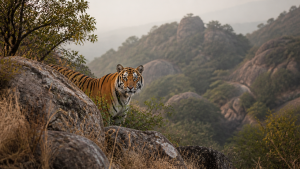
The Karnataka Forest Department confirmed the presence of a male tiger in the Kishkindha Hills of Koppal district on 24 August 2026. A camera trap installed in Temba village of Gangavathi taluk recorded the animal on 23 August 2026, and officials linked the sighting to a rare return of the species to the region after nearly five decades.
Tiger in India
The tiger is Panthera tigris, a large carnivore of the family Felidae. In India, the tiger is protected under the Wildlife (Protection) Act, 1972, and it is listed in Schedule I of the Act.
Camera Trap and Wildlife Monitoring
A camera trap is a remotely triggered device used to photograph or video-record wildlife without direct human presence. Forest departments in India use camera traps for species monitoring, population estimation, and movement tracking in forest landscapes.
In this case, 50 camera traps were deployed across Sanapura, Basapura, and Temba villages after local residents reported tiger sightings over several months. The use of multiple camera traps is a standard field method in wildlife surveillance in forested and hilly terrain.
Kishkindha Hills and Habitat Features
The Kishkindha Hills lie in Koppal district in north Karnataka, near the Hampi landscape. Wildlife officials identified dry deciduous forest and thorny scrub patches in the Sanapura-Basapura hill range as the tiger’s habitat.
Dry deciduous forests are seasonal forests that shed leaves during the dry period, while thorny scrub vegetation grows in low-rainfall areas with sparse tree cover. Such habitats can support prey species and provide cover for large carnivores.
Important Facts for Exams
- The tiger is the national animal of India and belongs to the genus Panthera.
- Camera traps are widely used in wildlife censuses and corridor studies in India.
- The Srisailam landscape is part of a major tiger habitat in the Eastern Ghats region.
- M. Y. Ghorpade was a former state minister and wildlife photographer associated with the last recorded tiger photograph in Koppal district.
Wildlife Corridor and Safety Measures
Forest officials formed a technical committee to examine the tiger’s origin and possible movement from the Srisailam wildlife corridor in Andhra Pradesh. The department also issued a safety advisory for residents in Hampi and nearby villages, asking them not to enter forest areas alone and not to sleep outdoors.
| Related | |
|---|---|