Starship Reaches Orbit as Super Heavy Booster Explodes
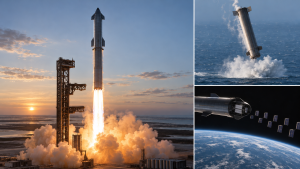
SpaceX launched its 15th Starship test flight, Flight 15, from Starbase, Texas, on 13 November 2026. The Super Heavy booster, Booster 22, malfunctioned during its return and was diverted to an offshore splashdown in the Gulf of Mexico, where it exploded. The malfunction prevented a planned catch by the launch tower’s mechanical arms, known as “chopsticks”.
Despite the booster failure, Starship’s upper stage, Ship 42, reached low Earth orbit at about 275 kilometres and deployed 26 Starlink V3 satellites. This was Starship’s first operational payload delivery and its second orbital flight, following Flight 14 in September.
Flight duration and planned recovery
The orbital flight is planned to last about 22 hours and complete 14 to 15 orbits. SpaceX plans to attempt to catch Ship 42 at Starbase on 14 November. If successful, it would be the first recovery of an orbital Starship upper stage.
Important Facts for Exams
- Vacuum-optimised engines: Starship Blocks 1–3 use six Raptor engines: three for sea-level operation and three optimised for the vacuum of space.
- Booster catch hardware: Two Super Heavy grid fins have hardpoints used to lift the booster onto its launch mount and catch it at the tower.
- Hot-staging separation: Starship uses hot-staging separation: its upper-stage engines ignite before the stages separate, while a vented interstage shields the booster from their exhaust.
- Raptor combustion cycle: Raptor is a full-flow staged-combustion engine, sending fuel and oxidiser through separate preburners before both propellant streams enter the main combustion chamber.
| Related | |
|---|---|