Scientists Validate Darwin’s Theory in Saxifraga candelabrum
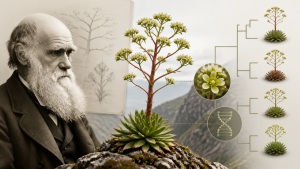
Saxifraga candelabrum, an alpine flowering plant native to the Qinghai-Tibet Plateau and the Hengduan Mountains of China, has been confirmed as carnivorous in a study published in Nature Communications on 4 August 2026. The finding provides evidence for Charles Darwin’s 1875 hypothesis that some Saxifraga species may trap and digest insects.
Carnivorous Plants
Carnivorous plants are flowering plants that capture, digest, and absorb nutrients from animals, mainly insects. They usually grow in nutrient-poor habitats, where nitrogen and phosphorus are limited in the soil.
Features of Saxifraga candelabrum
Saxifraga candelabrum grows at elevations above 2,500 metres and uses reddish sticky glandular hairs on its stems and branches to trap insects. Mature plants were found to catch an average of 70 small insects, mainly gnats, while larger pollinating flies were not trapped in the same way.
Scientific Methods Used
Researchers from the Kunming Institute of Botany of the Chinese Academy of Sciences and the Florida Museum of Natural History used fluorescence tagging for phosphatase activity and nitrogen isotope tracking. These methods confirmed that the plant digests captured insects and absorbs nitrogen from them.
Important Facts for Exams
- Charles Darwin published Insectivorous Plants in 1875, which discussed carnivorous plant behaviour.
- Saxifraga candelabrum is the first proven carnivorous plant in the family Saxifragaceae.
- Carnivorous plants are found in several families, including Droseraceae, Nepenthaceae, and Lentibulariaceae.
- Nitrogen isotope analysis is a standard method used to trace nutrient uptake in plant studies.
Genetic Evidence and Evolution
Genomic analysis found common genes between Saxifraga candelabrum and other independently evolved carnivorous plants. The result places botanical carnivory within the wider study of convergent evolution in flowering plants. Darwin first suspected carnivory in some Saxifraga species in 1875, but his experiments did not provide proof. The new finding is the first verified case of a meat-eating plant in the Saxifragaceae family.
| Related | |
|---|---|