Scientists Identify 2026 ED138 Beyond Pluto as Dwarf Planet Candidate
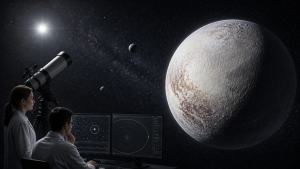
The International Astronomical Union’s Minor Planet Center announced 2026 ED138 as a possible dwarf planet on 27 October 2026. The icy object was detected beyond Pluto’s orbit by the Vera C. Rubin Observatory in Chile and is estimated to be between 600 and 1,500 kilometres in diameter.
Discovery and Observations
Astrophysicist Matthew Holman of the Center for Astrophysics | Harvard & Smithsonian identified 2026 ED138 in data collected by the Rubin Observatory during 2026. Archival images dating to 2016 also contain evidence of the object, which was missed because it appeared against a crowded star field. The observatory is located at Cerro Pachón in central Chile and uses a large digital camera to survey the sky.
Orbit and Location
2026 ED138 is estimated to orbit the Sun at a distance about 46 times the average Earth–Sun distance, or approximately 46 astronomical units (AU). Pluto’s average distance from the Sun is about 40 AU. The object lies in the trans-Neptunian region, beyond Neptune’s orbit. The Kuiper belt is a region of the Solar System beyond Neptune that contains icy bodies and extends roughly from 30 to 50 AU from the Sun.
Dwarf Planet Classification
The International Astronomical Union defines a dwarf planet as a body that orbits the Sun, has enough mass for its gravity to make it nearly round, has not cleared its orbital neighbourhood, and is not a satellite. Further observations, particularly in infrared light, are needed to refine 2026 ED138’s size and determine whether it meets the roundness criterion. Its provisional designation does not constitute confirmation as a dwarf planet.
Important Facts for Exams
- The International Astronomical Union adopted the dwarf planet category in 2006.
- The five currently recognised dwarf planets are Ceres, Pluto, Haumea, Makemake and Eris.
- Ceres is located in the asteroid belt, while Pluto, Haumea, Makemake and Eris are trans-Neptunian objects.
- An astronomical unit is the average distance between Earth and the Sun, approximately 150 million kilometres.
Recognised Dwarf Planets
If confirmed, 2026 ED138 would join the five currently recognised dwarf planets: Ceres, Pluto, Haumea, Makemake and Eris. The estimated diameter range of 2026 ED138 is 600–1,500 kilometres.
| Related | |
|---|---|