RBI and Government Roles in Currency Management
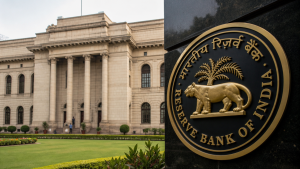
Currency management in India is a shared function of the Reserve Bank of India (RBI) and the Central Government, but their powers are not the same. The RBI manages paper currency and circulation, while the government retains authority over coinage and several key decisions relating to banknotes.
Legal Division of Powers in Currency Management
The Reserve Bank of India Act, 1934, and the Coinage Act, 2011, define the division of responsibility between the RBI and the Central Government.
- Banknote issuance: Section 22 of the RBI Act, 1934, gives the RBI the sole authority to issue banknotes in India. It manages the quantity, quality and circulation of banknotes through its issue offices and currency network.
- Denomination limits: Under Section 24 of the RBI Act, the Central Government decides banknote denominations up to a statutory limit of ₹10,000, on the recommendation of the RBI Central Board. The RBI cannot introduce a new denomination without government approval.
- Design approval: Section 25 of the RBI Act requires the Central Government to approve the design, form and material of banknotes after considering the RBI Central Board’s recommendations. This covers security features, paper composition and visual motifs.
- Demonetisation power: Section 26(2) of the RBI Act allows the Central Government, on the recommendation of the RBI Central Board, to declare any series of banknotes of any denomination as no longer legal tender through a gazette notification.
Coinage and One-Rupee Notes
Coins and one-rupee notes are governed by a separate legal framework from higher denomination banknotes.
- Minting authority: Under Section 4 of the Coinage Act, 2011, the Central Government has the sole authority to design, mint and determine the denominations of coins up to ₹1,000.
- Metal composition: The final decision on the metals and alloys used in coinage also rests with the government.
- Legal tender limits: Coins of value not less than ₹1 are legal tender up to ₹1,000 in a single transaction, while 50-paise coins are legal tender up to ₹10.
- One-rupee notes: One-rupee banknotes are issued directly by the Ministry of Finance and bear the signature of the Finance Secretary. They are currency, not RBI-issued banknotes.
- Coin distribution: The RBI acts as an agent of the Central Government for coin distribution. Coins enter circulation through the RBI’s currency chest network.
Currency Production Infrastructure
Banknotes and coins are produced in government-owned and central bank-owned facilities. These units work under public sector arrangements to support the cash system.
| Facility Type | Operating Authority | Locations |
| Banknote printing (Government) | SPMCIL, wholly owned by Government of India | Nashik (Maharashtra), Dewas (Madhya Pradesh) |
| Banknote printing (RBI) | BRBNML, wholly owned by RBI | Mysore (Karnataka), Salboni (West Bengal) |
| Coin minting | SPMCIL, wholly owned by Government of India | Mumbai, Hyderabad, Kolkata, NOIDA |
- Banknote printing presses: Security printing of banknotes is divided between four presses—two owned by the Government of India and two owned by the RBI’s wholly owned subsidiary, Bharatiya Reserve Bank Note Mudran Ltd (BRBNML).
- Coin mints: All four coin minting facilities are owned and operated by the Government of India and managed by SPMCIL.
- Paper manufacturing: Bank Note Paper Mill India Private Limited (BNPMIPL), Mysore, is a joint venture between BRBNML and SPMCIL and supplies security paper for Indian banknotes.
Clean Note Policy and ₹2,000 Note Status
The RBI’s Clean Note Policy, introduced in 1999, aims to ensure that good quality banknotes remain in circulation. Under this policy, the RBI withdrew ₹2,000 denomination banknotes on May 19, 2023.
- Legal tender status: ₹2,000 notes continue to remain legal tender.
- Return status: By April 30, 2026, 98.47% of the ₹2,000 notes in circulation on May 19, 2023, had been returned.
- Outstanding value: The value of ₹2,000 notes still in circulation had come down to ₹5,451 crore.
- Exchange facility: Exchange or deposit of ₹2,000 notes is restricted to the 19 designated RBI Issue Offices or through India Post to those offices.
- Retail bank handling: Retail banks no longer accept ₹2,000 notes over the counter.
Central Bank Digital Currency (CBDC)
The digital rupee or e-Rupee is India’s sovereign digital currency and represents an electronic form of fiat money. It is being tested in both wholesale and retail segments.
- Pilots: The RBI launched pilot testing in wholesale (e₹-W) and retail (e₹-R) segments.
- Legal status: The digital rupee has the same value and legal tender status as paper currency.
- Policy focus: The RBI’s stated focus includes cross-border payments, offline transactions through Near Field Communication (NFC), and direct benefit transfer (DBT) use cases.
Key Prelims Takeaways
- RBI Act, 1934: Section 22 gives the RBI the sole authority to issue banknotes.
- Banknote ceiling: The Central Government can decide banknote denominations up to ₹10,000 under Section 24 of the RBI Act.
- Design approval: The government approves the design, form and material of banknotes under Section 25 of the RBI Act.
- Demonetisation: Section 26(2) allows the Central Government to declare a banknote series as no longer legal tender on RBI Board recommendation.
- Coin ceiling: The Coinage Act, 2011 allows coins up to ₹1,000.
- One-rupee note: It is issued by the Ministry of Finance and signed by the Finance Secretary.
- ₹2,000 note: It remains legal tender despite being withdrawn from circulation under the Clean Note Policy.
| Related | |
|---|---|