National Workshop on Vulture Conservation Held in Panchkula
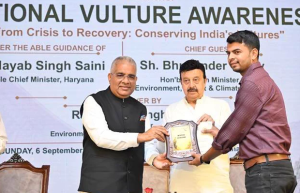
Union Minister for Environment, Forest and Climate Change Bhupender Yadav inaugurated a national workshop titled “From Crisis to Recovery – Conserving India’s Vultures” in Panchkula, Haryana, on 6 September 2026. The workshop was held to mark International Vulture Awareness Day and brought together institutions involved in vulture conservation, breeding, and wildlife management.
Workshop and participating institutions
The workshop was organised by the Ministry of Environment, Forest and Climate Change, the Central Zoo Authority, the Haryana Forest and Wildlife Department, the Bombay Natural History Society, and the Jatayu Conservation Breeding Centre. Panchkula is a district in Haryana and lies near the Shivalik foothills, which are part of the Himalayan foothill region.
Vulture decline in India
India’s vulture population declined sharply from the 1990s after exposure to diclofenac and other veterinary non-steroidal anti-inflammatory drugs in livestock carcasses. Vultures are scavenger birds that feed on animal remains and help in carcass disposal in ecosystems.
The main Indian vulture species include the White-rumped Vulture, Indian Vulture, Slender-billed Vulture, Red-headed Vulture, and Egyptian Vulture. Several of these species are listed as Critically Endangered or Endangered on the IUCN Red List.
Vulture Safe Zones and conservation breeding
Vulture Safe Zones are areas where veterinary diclofenac and other harmful drugs are restricted and carcass availability is monitored for scavenging birds. Conservation breeding centres in India maintain captive populations for species recovery and future release programmes.
The Jatayu Conservation Breeding Centre at Pinjore in Haryana is one of India’s vulture breeding facilities. Such centres are used for species recovery, genetic management, and long-term conservation planning.
Important Facts for Exams
- International Vulture Awareness Day is observed on the first Saturday of September every year.
- Diclofenac was identified as a major cause of vulture mortality in South Asia after carcass feeding.
- The Bombay Natural History Society is one of India’s oldest natural history organisations.
- Vultures are classified as obligate scavengers in ecological studies.
India has several vulture conservation breeding centres, including facilities linked to the Central Zoo Authority. Vulture conservation is connected to wildlife health, carcass management, and veterinary drug regulation.
| Related | |
|---|---|