NASA PRAXIS Mission to Study Planetary Rings
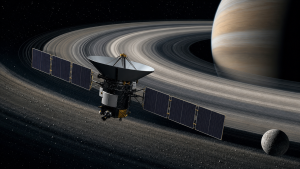
NASA proposed the PRAXIS mission on 26 July 2026 for direct study of planetary ring particles. PRAXIS stands for Planetary Rings Autonomous EXploration with In-situ Sampling and is designed to collect and analyse real particles from Saturn’s rings.
Planetary Rings
Planetary rings are disc-shaped collections of dust, ice, and rock that orbit planets within the planet’s Roche limit or near it. Saturn, Jupiter, Uranus, and Neptune have ring systems, and Saturn has the most extensive and visible rings in the Solar System.
Mission Concept and Sampling Method
PRAXIS uses an AI-powered, bio-inspired robotic system with a long deployable boom. The system is designed for touch-and-go sampling, which allows collection of ring particles without direct collision with the ring structure. The mission aims to sample millimetre to centimetre-scale particles, which are larger than dust grains and smaller than pebbles. Onboard instruments will examine particle size, porosity, and composition in space after collection.
NASA NIAC and Mission Development
NASA selected the PRAXIS concept for Innovative Advanced Concepts 2026 Phase I funding in March 2026. The NIAC programme supports early-stage studies of advanced aerospace concepts, including simulations and system design work. Dr B. Marco Quadrelli, Principal and Group Supervisor of the Robotics Modelling and Simulation Group at NASA’s Jet Propulsion Laboratory, leads the PRAXIS project.
Important Facts for Exams
- Cassini was a NASA-ESA mission that studied Saturn and its rings from 2004 to 2017.
- Saturn’s rings are made mainly of water ice with smaller amounts of dust and rocky material.
- Uranus and Neptune also have ring systems, but they are much fainter than Saturn’s rings.
- NASA’s Jet Propulsion Laboratory is located in Pasadena, California, and manages many robotic space missions.
Scientific Relevance
PRAXIS is intended to address questions on ring formation, particle dynamics, and ring evolution. The technology developed for the mission may also support future exploration of ring systems around Uranus and Neptune.
| Related | |
|---|---|