NASA and SpaceX Launch Crew-13 Mission
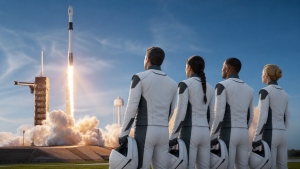
The NASA and SpaceX Crew-13 mission launched on 1 October 2026 at 11:10 a.m. EDT from Space Launch Complex 40 at Cape Canaveral Space Force Station in Florida. The mission carried four crew members to the International Space Station for a six-month science expedition aboard the Crew Dragon spacecraft named Grace, launched by a Falcon 9 rocket.
Crew Composition
The Crew-13 team included NASA astronauts Jessica Watkins, who served as Commander, and Luke Delaney, who served as Pilot. The other two crew members were Canadian Space Agency astronaut Joshua Kutryk and Roscosmos cosmonaut Sergey Teteryatnikov. The mission reflected a multinational crew arrangement used in International Space Station operations.
Spacecraft and Launch Vehicle
Crew Dragon is a reusable crewed spacecraft developed by SpaceX for transport to low-Earth orbit. Falcon 9 is a two-stage orbital launch vehicle used for crewed and cargo missions. The first stage used for Crew-13 had previously launched Crew-12 and one Starlink mission, and it landed at Landing Zone 40 at Cape Canaveral Space Force Station.
Docking, Transit Time and ISS Operations
Crew Dragon Grace docked autonomously with the forward port of the Harmony module on the ISS on 1 October 2026 at 7:05 p.m. EDT. The journey took 7 hours and 55 minutes, which set a new record for the fastest trip to the ISS by an American spacecraft. The hatches opened at 9:19 p.m. EDT on 1 October 2026, and the crew joined Expedition 75.
Important Facts for Exams
- The International Space Station is a modular orbital laboratory that has been continuously inhabited since November 2000.
- The Harmony module is one of the main connecting nodes of the ISS and supports docking ports for visiting spacecraft.
- Falcon 9 is a partially reusable launch vehicle, and its first stage is designed to land vertically after launch.
- SpaceX Crew Dragon missions are part of NASA’s Commercial Crew Programme, which uses private spacecraft for astronaut transport.
Mission Delay and Research Objectives
The mission faced an earlier delay from a scheduled 12 September 2026 launch after a propellant oxidiser leak was detected in the Crew Dragon Grace spacecraft. During the ISS stay, the crew will conduct research on human stem cell-derived tissues for personalised medicine, disease modelling, and technologies needed for deep-space missions.
| Related | |
|---|---|