Microbial Biofilms and Their Role in Human Infections
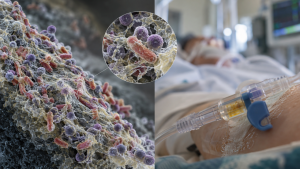
Microbial biofilms are surface-attached communities of microorganisms enclosed in a self-produced extracellular polymeric substance (EPS) matrix. They can persist on body tissues and medical devices, contributing to chronic, recurrent and difficult-to-treat infections.
What Are Microbial Biofilms?
A biofilm is a community of one or more microbial species growing on a surface and embedded in an EPS matrix. The matrix is made mainly of polysaccharides, proteins, nucleic acids and lipids. It gives the community structural integrity and helps protect its cells from environmental stress. Biofilms can develop on living tissues as well as inert materials, including catheters, prosthetics and implants. This protected mode of growth helps microorganisms persist in conditions that would be hostile to free-floating, or planktonic, cells.
Biofilm Formation
Biofilm development is generally described in five stages:
- Initial attachment: Planktonic cells make a reversible contact with a surface.
- Irreversible attachment: Cells adhere more firmly, using structures such as pili, fimbriae or flagella.
- Early maturation: Microorganisms produce EPS and form microcolonies. They also communicate through quorum sensing.
- Further maturation: The community develops a more complex architecture, including water channels, and becomes enclosed in the EPS matrix.
- Dispersal: Individual cells or clusters leave the mature biofilm and return to a planktonic state, enabling colonisation of new sites.
Human Infections and Clinical Significance
Biofilms are associated with persistent and recurrent infections because they can limit the effectiveness of antimicrobial treatment and host immune responses. Device-associated infections are a major concern: catheters, prosthetics and implants can provide surfaces on which biofilms form. These infections contribute to the challenge of managing hospital-acquired infections and can place additional demands on health system capacity. Biofilms also affect wounds and several body systems:
- Chronic wounds: Biofilms can impair healing and prolong inflammation.
- Urinary tract: Biofilms on the bladder wall or catheters can contribute to persistent or recurrent UTIs.
- Lungs: In people with cystic fibrosis, biofilm-forming Pseudomonas aeruginosa is associated with persistent lung infection and progressive lung damage.
- Oral cavity: Dental plaque is a biofilm associated with dental caries and periodontal disease.
- Heart and bone: Bacterial biofilms on heart valves can be associated with endocarditis; biofilm-forming bacteria are also linked to osteomyelitis, including after surgery.
- Fungal disease: Candida albicans can form biofilms that increase resistance to antifungal treatment.
Antimicrobial Resistance and Important Pathogens
Biofilm-associated microorganisms are generally less susceptible to antimicrobial agents than their planktonic counterparts. This reduced susceptibility can make treatment less effective, but it arises through several interacting mechanisms:
- Matrix and microenvironment: EPS can restrict antimicrobial penetration. Gradients in oxygen and pH within a biofilm can also reduce the activity of some drugs.
- Slow growth and persistence: Slowly growing or dormant cells may be less affected by drugs that target rapidly dividing cells. Persister cells can survive treatment and help repopulate a biofilm after it ends.
- Cellular changes: Altered gene expression can increase the production of efflux pumps or antibiotic-degrading enzymes.
- Gene exchange: Close contact between cells can facilitate horizontal transfer of genetic material, including antibiotic-resistance genes.
Clinically important biofilm-forming microorganisms include:
- Pseudomonas aeruginosa: Associated with chronic lung infections in cystic fibrosis and wound infections.
- Staphylococcus aureus: Associated with infections involving medical implants, surgical sites and the bloodstream.
- Escherichia coli and Klebsiella pneumoniae: Linked to urinary tract infections; K. pneumoniae can also form biofilms in respiratory infections.
- Candida albicans and Streptococcus mutans: C. albicans forms biofilms in fungal infections, including on catheters, while S. mutans contributes to dental plaque and caries.
Key Prelims Takeaways
- A biofilm is a surface-attached microbial community enclosed in an EPS matrix.
- EPS contains polysaccharides, proteins, nucleic acids and lipids, and supports the biofilm’s structure and protection.
- Formation proceeds through attachment, maturation and dispersal; quorum sensing occurs as microcolonies develop.
- Biofilms are associated with chronic infections and infections involving medical devices.
- Reduced antimicrobial susceptibility can involve restricted drug penetration, altered growth, persister cells, gene-expression changes and gene transfer.
- Candida albicans can change from a rounded yeast form to filamentous forms, a process known as morphogenesis.
Recent Context
In November 2026, CSIR-CCMB researchers identified two compounds targeting glycolysis that block C. albicans morphogenesis; pyruvate kinase was identified as a key regulator. One compound reduced biofilm formation and enhanced fluconazole and amphotericin B effectiveness. A lead compound improved survival in a mouse model; further safety and efficacy studies are needed. The findings appeared in ACS Infectious Diseases.
| Related | |
|---|---|