Major Planetary Defence Missions and Technologies
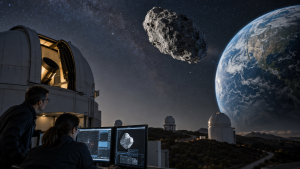
Planetary defence combines the discovery and tracking of near-Earth objects (NEOs) with plans to reduce the risk of a dangerous impact. Its effectiveness depends on early warning, reliable knowledge of an object’s physical properties and coordinated international action.
Asteroid and Comet Threats
- Near-Earth objects: NEOs are asteroids or comets whose orbits bring them close to Earth’s orbit. They are remnants of the Solar System’s formation, but their varied sizes, compositions and trajectories create different levels of risk.
- Asteroids and comets: Asteroids are rocky bodies found mainly in the belt between Mars and Jupiter; their compositions include carbonaceous, silicaceous and metallic types. Comets are icy bodies originating in the outer Solar System, including the Kuiper Belt and Oort Cloud, and can develop a coma and tail as they approach the Sun.
- Potentially Hazardous Asteroids (PHAs): This category generally includes asteroids larger than about 140 metres whose orbits bring them within 0.05 astronomical units (about 7.5 million kilometres) of Earth. An impact by an object of this size could cause significant regional or, in some cases, continental damage.
Regular surveys and follow-up observations help determine an object’s orbit, physical properties and possible impact probability. Warning time is crucial: a small change in an object’s path made well in advance can produce a much larger separation from Earth at a later encounter.
Detection and Tracking
- Ground-based surveys: Catalina Sky Survey, Pan-STARRS and ATLAS scan the sky for NEOs. Repeated observations allow astronomers to identify moving objects and refine estimates of their paths.
- Infrared observations: Space-based infrared surveys such as NASA’s NEOWISE have helped detect NEOs, including objects that may be difficult to identify in visible light. Infrared measurements can also contribute to estimates of an object’s size.
- Orbit and risk assessment: Follow-up observations from observatories improve orbital calculations. Computational models use these observations to project close approaches and assess impact probabilities; continued measurements can refine or change an initial risk estimate.
Detection is only the first step. Characterising an object’s size, composition and structure helps determine which mitigation approach could work and how much warning time it would require.
Planetary Defence Strategies
- Kinetic impactor: A spacecraft collides with an asteroid to change its velocity and, over time, its trajectory. NASA’s DART mission tested this approach at full scale by striking Dimorphos, the moonlet of Didymos.
- Gravity tractor: A spacecraft remains near an asteroid for an extended period, using its gravitational attraction to alter the object’s path gradually. The method would require substantial lead time and is suited to a slow, controlled deflection.
- Nuclear deflection: A nuclear device detonated near or on an asteroid has been proposed as a way to impart energy and change its path. It is generally considered a last-resort option for a large object approaching with limited warning.
- Laser ablation and solar sails: Laser ablation would vaporise surface material, producing a jet that could push an asteroid. Solar sails would use sunlight pressure to change its trajectory slowly. Both concepts require significant lead time; laser ablation remains at an early development stage.
The appropriate response would depend on the object and the time available. A planned deflection is preferable to relying on a last-minute intervention, making early detection and international preparedness essential parts of planetary defence.
Major Missions and Technologies
- DART: NASA launched the Double Asteroid Redirection Test in November 2021. On September 26, 2022, it struck Dimorphos, the moonlet of the binary asteroid Didymos. The collision shortened Dimorphos’s orbital period around Didymos by 33 minutes, a greater change than initially predicted.
- Hera: The European Space Agency (ESA) launched Hera aboard a SpaceX Falcon 9 on October 7, 2024. It arrived at the Didymos system in early November 2026 to investigate the site and effects of DART’s impact. Braking manoeuvres on October 15 and 22 slowed its approach and enabled it to enter orbit around the system.
- Hera observations: On October 18, 2026, its Asteroid Framing Camera imaged Didymos and Dimorphos as separate objects from about 1,280 kilometres away. On November 5, Hera obtained an image of Didymos from about 60 kilometres away, showing boulders, craters and an equatorial ridge.
- Hera’s investigation: The spacecraft is tasked with mapping the asteroids, measuring Dimorphos’s mass and examining its interior. Its assessment will relate momentum transfer from DART to factors including density, porosity, and surface and internal structure, helping explain the observed orbital shift.
- CubeSats: Hera carries Milani and Juventas. Milani is designed to collect spectral data on both asteroids’ surface composition and detect surrounding dust. Juventas carries JuRa, a 50–70 MHz radar with 10–15 metre resolution, designed to probe an asteroid’s inner layers.
NASA’s OSIRIS-REx mission to Bennu and JAXA’s Hayabusa2 mission to Ryugu returned asteroid samples. Data from these missions on asteroid composition and physical properties can inform the assessment of objects and the planning of possible mitigation measures.
International Cooperation
- International Asteroid Warning Network (IAWN): This international collaboration brings together observatories, survey programmes and data-analysis centres to detect, track and characterise NEOs and facilitate the timely sharing of impact warnings.
- Space Mission Planning Advisory Group (SMPAG): SMPAG develops international guidelines and recommendations for planning missions to address an asteroid impact threat, including coordination of technical aspects.
- United Nations Committee on the Peaceful Uses of Outer Space (COPUOS): COPUOS provides a forum for international cooperation on the peaceful uses of space, including planetary-defence discussions. Shared observation and planning support global risk preparedness.
Key Prelims Takeaways
- PHA threshold: Generally larger than 140 metres and within 0.05 AU of Earth.
- DART: NASA kinetic-impactor mission; struck Dimorphos on September 26, 2022, changing its orbital period by 33 minutes.
- Hera: ESA mission launched October 7, 2024; arrived at the Didymos system in early November 2026.
- Juventas and Milani: Carry JuRa radar for interior probing and instruments for spectral study of surface composition and dust detection, respectively.
- IAWN and SMPAG: Support NEO warning and international mission-planning coordination, respectively.
- NEOWISE: NASA space-based infrared survey mission that contributed to NEO detection.
Recent Context
Hera’s close-up observations of Didymos on November 5, 2026, revealed boulders, craters and an equatorial ridge. Detailed images of Dimorphos are expected to be released on November 25, 2026.
| Related | |
|---|---|