Major Grassland and Scrubland Ecosystems of India
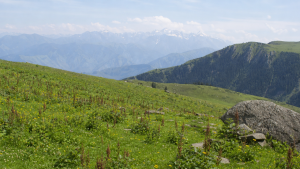
India’s grasslands and scrublands range from Himalayan alpine pastures to semi-arid plains and dry thorn scrub. Though often overlooked beside forests, they support distinctive wildlife, sustain grazing and ecological processes, and face growing pressure from land-use change.
Types of Grassland Ecosystems
India’s grasslands vary with altitude, rainfall and soils. Many are mosaics of grasses, shrubs and scattered trees rather than treeless expanses.
- Himalayan alpine pastures: Known as bugyals, these occur above the tree line, generally at elevations of 3,300–4,000 metres. Their vegetation grows seasonally, with flowering plants appearing in summer. Himalayan Tahr and Snow Leopard use these high-altitude landscapes.
- Shola grasslands: Found in the high Western Ghats, including the Nilgiri, Anaimalai and Palani hills, these form a mosaic with patches of stunted evergreen Shola forest. They are important watershed areas and provide habitat for the endemic Nilgiri Tahr.
- Terai-Duar grasslands: These tall, dense grasslands occur along the Himalayan foothills, from Uttarakhand towards Arunachal Pradesh. They support large mammals, including rhinoceroses, elephants and tigers, in landscapes that include protected areas such as Kaziranga and Manas National Parks.
- Semi-arid and arid grasslands: Common in western India, including Rajasthan and Gujarat, and parts of the Deccan Plateau, these habitats are adapted to low rainfall and high temperatures. Coarse grasses and thorny shrubs provide habitat for species such as the Great Indian Bustard, Blackbuck and Indian Wolf.
- Deccan and peninsular grasslands: These include dry grasslands and savannah-like landscapes, often with scattered trees such as Acacia. Their composition varies across the plateau and adjoining regions.
Ecological Characteristics and Species
Grasslands are open ecosystems in which grasses and other herbaceous plants dominate, with limited tree cover. Scrublands, also called thorn forests or bushlands, are characterised by low, dry vegetation, including thorny shrubs and small trees. Both are shaped by local climate, soils and water availability.
- Climate adaptations: Many scrubland plants have small leaves or thorns that help limit water loss. Scrublands are especially common in areas receiving less than 70 cm of annual rainfall and experiencing prolonged dry seasons.
- Grass flora: Common grass genera include Cenchrus, Sehima, Dichanthium, Panicum and Bothriochloa.
- Scrub flora: Characteristic plants include Acacia nilotica, Prosopis cineraria, Capparis decidua and Ziziphus mauritiana. The invasive Prosopis juliflora also occurs in Indian scrublands.
- Fauna: Grasslands and scrublands support Blackbuck, Chinkara, Indian Wolf, Striped Hyena and, in the Rann of Kutch, the Indian Wild Ass. The Great Indian Bustard is a critically endangered grassland bird; other birds include harriers, larks, sandgrouse and raptors. Reptiles include snakes, lizards and the Spiny-tailed Lizard.
Ecological Significance and Pressures
These ecosystems support food webs and connect forest, desert and agricultural landscapes. Their conservation is important for biodiversity protection as well as for sustaining ecological functions and local livelihoods.
- Soil and water: Extensive grass roots help bind soil, reduce erosion and promote water infiltration. Grasslands also contribute to nutrient cycling and carbon storage.
- Grazing and food webs: They provide grazing grounds for livestock and wild herbivores. Herbivores, in turn, support predators and other parts of the food web.
- Habitat loss and fragmentation: Conversion to agriculture, urban growth and infrastructure can reduce habitat area and interrupt wildlife movement.
- Degradation: Overgrazing can erode soil and favour unpalatable species. Mining and unsustainable land management also disturb or remove habitat; desertification is a particular concern in arid and semi-arid regions.
- Invasive species and fire: Prosopis juliflora and Lantana camara can outcompete native vegetation. Natural and human-caused fires may alter grassland structure and composition.
Conservation Framework and Initiatives
Conserving grasslands requires attention to habitat condition and land-use pressures, alongside protection of individual species. Relevant laws and programmes include:
- Wildlife (Protection) Act, 1972: Provides for protection of wild animals, birds and plants, and enables the establishment of Protected Areas such as National Parks and Wildlife Sanctuaries.
- Forest (Conservation) Act, 1980: Regulates the diversion of forest land for non-forest purposes. The Biological Diversity Act, 2002, provides for biodiversity conservation, sustainable use and fair and equitable sharing of benefits from biological resources.
- National Afforestation Programme and IDWH: The National Afforestation Programme focuses on ecological restoration of degraded forests and adjoining lands. The centrally sponsored Integrated Development of Wildlife Habitats scheme supports wildlife and habitat conservation.
- Species-focused initiatives: Project Great Indian Bustard targets conservation of the critically endangered bird and its grassland habitat. The National Tiger Conservation Authority (NTCA) is the nodal agency for Project Cheetah, which reintroduced cheetahs into India.
Key Prelims Takeaways
- Bugyals: Himalayan alpine pastures above the tree line.
- Shola grasslands: High-altitude Western Ghats mosaics with evergreen Shola forest.
- Scrub adaptation: Thorny or small-leaved vegetation is suited to dry conditions; Prosopis juliflora is invasive.
- Great Indian Bustard: A critically endangered bird associated with grassland habitats.
- Project Cheetah: Launched on 17 September 2022; NTCA is its nodal agency.
- Cheetah identification and behaviour: Each has a distinctive coat-spot pattern; females generally range over larger areas, while males are more sedentary. A hunting charge may trip prey with the dewclaw.
Recent Context
As of 1 November 2026, male cheetah CCB-4 was in the Anjaronda forest area of Rajasthan’s Kelwara range after travelling about 16 km from Kuno National Park, Madhya Pradesh. Teams from Kuno and Kelwara were tracking the cheetah in Baran’s open scrub and grasslands, which support prey such as chital and chinkara.
| Related | |
|---|---|