Important Facts about Cheetahs and Their Habitat in India
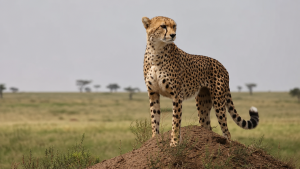
Cheetahs are specialised predators adapted to open landscapes, and their return to India is linked to species conservation and grassland restoration. Understanding their biology, historical range, habitat needs and the objectives of Project Cheetah is important for assessing the initiative’s opportunities and challenges.
Cheetah: Characteristics and Behaviour
The cheetah, Acinonyx jubatus, is the fastest land animal, reaching speeds above 100 km/h in short bursts. It is the only living member of the genus Acinonyx. Its semi-retractable claws provide traction during rapid acceleration and sharp turns. The cheetah has a slender, long-legged body, deep chest, narrow waist and small, rounded head. Its tawny to pale-buff coat has solid black spots; each animal’s distinctive pattern can be used for individual identification. Black tear marks run from the inner corners of the eyes to the mouth and are thought to reduce glare during daytime hunts. Unlike other big cats, cheetahs cannot roar; they communicate through chirps, purrs, barks, growls and hisses. Cheetahs hunt by stalking prey before making a short, high-speed charge. Their diet mainly comprises small to medium-sized ungulates, generally weighing less than 40 kg. The hunting sequence includes:
- Stalking prey from about 30–200 metres away.
- Charging at high speed and tripping the prey with the dewclaw.
- Delivering a throat bite to kill the prey.
Females are generally solitary and nomadic, ranging widely, particularly when raising cubs. A litter usually has three to six cubs, following a gestation period of about 90–95 days. Males are more sedentary and may form coalitions of two or three, usually brothers, to defend smaller territories with access to prey and females.
Historical Presence and Extinction in India
The Asiatic cheetah, Acinonyx jubatus venaticus, historically ranged across the Indian subcontinent, from Afghanistan and Iran in the west to Bengal in the east and south to Tamil Nadu. Excessive hunting, including capture for use in hunts, contributed to its decline during the Mughal and British periods. Emperor Akbar is recorded as having maintained a collection of up to 10,000 cheetahs during his reign. Agricultural expansion and human settlement reduced habitat, while depletion of prey such as blackbuck and chinkara further weakened populations. The last three documented Asiatic cheetahs in India were shot in 1947 by Maharaja Ramanuj Pratap Singh Deo of Surguja in the Sal forests of Koriya district, in present-day Chhattisgarh. The species was declared extinct in India in 1952.
Project Cheetah
Project Cheetah is a Government of India initiative to reintroduce cheetahs and establish a viable, free-ranging population. It is the world’s first intercontinental translocation of a large carnivore. The National Tiger Conservation Authority (NTCA), under the Ministry of Environment, Forest and Climate Change, is the project’s nodal agency. Its objectives include restoring the cheetah’s ecological role as a top predator, supporting global cheetah conservation, and contributing to grassland ecosystems and biodiversity. The initiative also seeks to generate socio-economic benefits through ecotourism and community development. African cheetahs, Acinonyx jubatus jubatus, were selected for reintroduction. The critically endangered Asiatic cheetah population in Iran is too small for such a programme. Kuno National Park in Madhya Pradesh was chosen as the primary release site for its habitat and prey base. Eight cheetahs arrived from Namibia in September 2022, followed by 12 from South Africa in February 2023. CCB-4 arrived from Botswana on February 28, 2026, as part of the third batch. Cheetahs are monitored using radio collars and their individual coat-spot patterns.
Habitat, Prey and Conservation Challenges
Cheetahs prefer open habitats such as grasslands, savannas and semi-arid scrub, where less-dense vegetation allows them to pursue prey. A sufficient prey base is essential to support a free-ranging population. In India, potential prey includes chital, chinkara and young nilgai. The species’ conservation depends on protecting suitable habitat and prey while addressing human-wildlife coexistence. Major threats include habitat loss and fragmentation, prey depletion, conflict that can lead to retaliatory killings, and poaching, including the capture of cubs for the exotic pet trade. Historically low genetic diversity also increases susceptibility to disease and can affect reproductive success. Globally, the cheetah is classified as Vulnerable on the IUCN Red List. The Asiatic cheetah in Iran and the Northwest African cheetah, Acinonyx jubatus hecki, are classified as Critically Endangered. The species is listed in Appendix I of both CITES and the Convention on Migratory Species (CMS). CITES Appendix I listing prohibits international commercial trade in the species.
Key Prelims Takeaways
- Scientific name: Acinonyx jubatus; the Asiatic subspecies is A. j. venaticus.
- Distinctive traits: Fastest land animal; semi-retractable claws, black tear marks and a unique coat-spot pattern.
- Social behaviour: Females are generally nomadic; males are more sedentary and may form coalitions, usually of brothers.
- India’s extinction: The Asiatic cheetah was declared extinct in India in 1952; the last three documented animals were shot in 1947.
- Project Cheetah: NTCA is the nodal agency; Kuno National Park is the primary reintroduction site.
- Conservation status: Globally Vulnerable; listed in Appendix I of CITES and CMS.
Recent Context
On a Friday night before November 1, 2026, CCB-4 moved from Kuno into Rajasthan’s Baran district. By November 1, he was in Anjaronda forest, having covered about 16 kilometres; teams from Kuno and the Kelwara forest range are tracking him jointly.
| Related | |
|---|---|