Major Mars Exploration Missions and Programmes
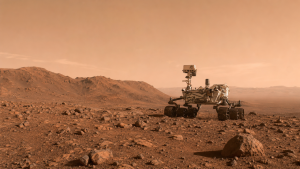
Mars exploration has progressed from brief flybys to long-running orbiters, robotic landers and rovers. Together, these missions investigate the planet’s geology, climate, water history and potential habitability, while shaping priorities for future robotic and human exploration.
Early Exploration and First Landings
Early Mars missions established the basic sequence of exploration: close-range imaging, orbital mapping and surface investigation. Many early attempts failed, but several missions set lasting milestones.
- Mariner 4 (NASA, 1964): Its 1965 flyby was the first successful encounter with Mars and returned the first close-up images, showing a heavily cratered surface.
- Mariner 6 and 7 (NASA, 1969): These successful flybys returned hundreds of images and collected atmospheric data.
- Mariner 9 (NASA, 1971): The first spacecraft to orbit another planet, it mapped about 80% of Mars. Observations made after dust storms subsided revealed features including volcanoes and canyons.
- Mars 2 and Mars 3 (Soviet Union, 1971): Mars 2’s lander failed during its attempted landing. Mars 3 achieved the first soft landing on Mars, but transmitted for only about 20 seconds.
- Viking 1 and 2 (NASA, 1975): Each mission combined an orbiter and lander. The landers conducted long-duration surface operations and experiments seeking signs of microbial life; the results were inconclusive.
Major Orbiter Missions
Orbiters provide global observations of the surface and atmosphere, help trace water-related changes and relay data from surface missions. Their long operating periods have also enabled comparisons across seasons and years.
- Mars Global Surveyor (NASA, 1996): Operating for more than nine years, it studied the surface, atmosphere and interior. Its work included identifying water-related mineral deposits, improving topographic maps and relaying data for later missions.
- Mars Odyssey (NASA, 2001): It searched for evidence of water and volcanic activity, detected abundant water ice just below the surface and produced global maps of surface minerals.
- Mars Express (ESA, 2003): Europe’s first Mars mission successfully entered orbit. Its Beagle 2 lander was lost, while the orbiter conducted high-resolution imaging, investigated the history of water and studied Phobos and Deimos.
- Mars Reconnaissance Orbiter (NASA, 2005): MRO searches for evidence of long-lasting surface water. Its HiRISE camera provides high-resolution images; the spacecraft also supports surface missions through data relay and has helped assess landing sites.
- MAVEN (NASA, 2013): The Mars Atmosphere and Volatile Evolution mission investigates how the atmosphere has changed and continues to escape into space, including the role of atmospheric loss in climate and habitability.
- Mangalyaan or Mars Orbiter Mission (ISRO, 2013): India’s first interplanetary mission successfully entered Mars orbit. Its objectives included studying surface features, morphology, mineralogy and the atmosphere.
- Hope, or Al-Amal (UAE, 2020): The Arab world’s first interplanetary mission reached Mars in February 2021. It studies how the atmosphere varies through the day, seasons and year.
Landers and Rovers
Surface missions directly examine rocks, soil and local conditions. Their findings complement orbital observations, although each landing site represents only a limited part of Mars.
- Sojourner (NASA, 1997): Part of Mars Pathfinder, it was the first wheeled vehicle to operate on Mars. It examined rocks and soil in the Ares Vallis region.
- Spirit and Opportunity (NASA, 2003): Designed for 90-day missions, the twin Mars Exploration Rovers operated far beyond their planned lifetimes. They found evidence of past water activity and conditions that could have supported microbial life. Spirit operated until 2010 and Opportunity until 2018.
- Curiosity (NASA, 2011): The Mars Science Laboratory rover landed in Gale Crater. It found evidence that Mars once had conditions favourable to microbial life, including essential chemical ingredients and energy sources.
- Perseverance (NASA, 2020): Operating in Jezero Crater, it searches for signs of ancient life and studies geology and climate. It is collecting rock and regolith samples for possible future return to Earth.
- Ingenuity: Deployed by Perseverance, the helicopter achieved the first powered, controlled flight on another planet.
- Zhurong (CNSA, 2021): Part of China’s Tianwen-1 mission, it soft-landed in Utopia Planitia. Its instruments investigate subsurface water ice and surface composition.
Scientific and Strategic Significance
The missions address connected questions: how Mars formed, how its atmosphere and climate changed, where water has been present and whether past environments could have supported life. Orbital data guide the selection and interpretation of landing sites, while rovers test local geology directly. Sample collection by Perseverance adds a further step towards detailed study on Earth. Mars exploration also reflects differing national capabilities and priorities. NASA, the Soviet Union, ESA, ISRO, the UAE and CNSA have each contributed missions or instruments to the exploration record. Cooperation and data relay are important to sustained robotic exploration, while mission choices balance planetary science research against broader space-exploration priorities. The search for habitability is not equivalent to evidence that life existed: Viking’s biological experiments, for example, produced inconclusive results.
Key Prelims Takeaways
- First successful Mars flyby: NASA’s Mariner 4, in 1965.
- First spacecraft to orbit Mars: NASA’s Mariner 9, in 1971.
- First soft landing on Mars: Soviet Mars 3, in 1971; its transmission lasted about 20 seconds.
- First long-duration lander operations: NASA’s Viking 1 and 2, which also conducted experiments to search for life.
- First wheeled rover on Mars: Sojourner, part of the Mars Pathfinder mission, in 1997.
- National mission milestones: Mangalyaan was India’s first Mars mission; Hope was the Arab world’s first interplanetary mission; Tianwen-1 combined China’s orbiter, lander and rover programme.
- Key landing sites: Perseverance landed in Jezero Crater; Zhurong landed in Utopia Planitia.
Recent Context
On October 31, 2026, NASA’s four-member CHAPEA Mission 2 crew completed a 378-day simulated Mars mission at Johnson Space Center. The crew lived in a 3D-printed habitat, managing resources and communication delays. The study is intended to inform human missions to the Moon and Mars.
| Related | |
|---|---|