Role of Gram Sabhas in Forest Governance and Rights Recognition
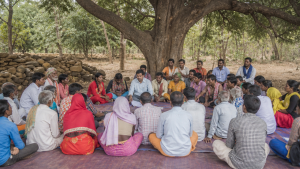
The Forest Rights Act, 2006 places the Gram Sabha at the start of the process for identifying and recommending forest rights claims. Its role links local self-governance and participatory decision-making with the recognition of individual and community rights, while higher-level committees screen and approve claims.
The Forest Rights Act, 2006
The Scheduled Tribes and Other Traditional Forest Dwellers (Recognition of Forest Rights) Act, 2006—commonly called the Forest Rights Act (FRA)—seeks to address historical injustice by recognizing the rights of forest-dwelling communities. It came into force on December 31, 2007. The Ministry of Tribal Affairs is the nodal ministry for its implementation.
- Rights covered: The Act recognizes title, use, relief and development, and forest management rights.
- Approach: It establishes a decentralized process in which local claims are considered before administrative screening and approval.
- Beneficiaries: Rights may be recognized for eligible Forest Dwelling Scheduled Tribes and Other Traditional Forest Dwellers.
Gram Sabha’s Role in Recognition
The Gram Sabha is the foundational statutory body in the claims process. Claims are first submitted to it; it considers evidence and traditional boundaries and passes a resolution recommending which rights should be recognized. This local scrutiny is intended to make the process responsive to communities’ knowledge and use of forest areas.
- Receiving claims: Individuals and communities submit forest-rights claims to the Gram Sabha.
- Verification: The Gram Sabha, assisted by its Forest Rights Committee, examines the nature and extent of claims against available evidence and traditional boundaries.
- Recommendation: It adopts a resolution on the claims and forwards it for consideration by the Sub-Divisional Level Committee.
- Community forest resources: The Act recognizes the right of eligible communities to protect, regenerate, conserve or manage community forest resources they have traditionally protected and conserved.
The Gram Sabha’s resolution is an important stage, but it is not the final approval of a claim: sub-divisional and district-level bodies screen and approve it. This distinction matters when assessing claims about the validity of a resolution or whether a community was adequately involved. The Gram Sabha’s central role also makes it a key forum for participatory decision-making on local forest rights. Questions of community consent in decisions affecting forest land must be considered through the applicable legal process; the Gram Sabha’s recommendation should not be confused with final administrative approval.
Rights Recognized under the FRA
The Act recognizes individual and community rights, covering occupation, livelihoods, access to resources and community management.
- Individual Forest Rights (IFRs): Eligible claimants may hold and live on forest land under individual or common occupation for habitation or self-cultivation, subject to a ceiling of four hectares.
- Settlement rights: The Act provides for the conversion of forest villages, old habitations and unsurveyed settlements into revenue villages.
- Minor forest produce: Community rights include collecting, using and disposing of minor forest produce.
- Other resource use: Rights may include grazing, seasonal access by pastoralist communities, fishing and other products of water bodies.
- Habitat and knowledge: The Act recognizes habitat rights for Primitive Tribal Groups and pre-agricultural communities, as well as access to biodiversity and intellectual property rights related to traditional knowledge.
- Relief and development: Recognized rights include relief and development rights, including rehabilitation where forest land is diverted for government development projects.
Eligibility for Claims
The FRA sets distinct eligibility tests for Forest Dwelling Scheduled Tribes (FDSTs) and Other Traditional Forest Dwellers (OTFDs). Both categories must depend on forests or forest land for bona fide livelihood needs.
- FDSTs: A claimant must belong to a Scheduled Tribe in the area where the right is claimed and have resided there before December 13, 2005.
- OTFDs: A claimant must show residence on forest land for three generations, defined as 75 years, before December 13, 2005.
Committees and the Claims Process
The FRA uses a three-tier process. The Gram Sabha initiates consideration and recommends claims; committees at the sub-divisional and district levels then screen and approve the resolutions. The committees combine officials with elected local-body members and also hear appeals.
- Forest Rights Committee (FRC): Constituted by the Gram Sabha, it receives claims, prepares a list of claimants and assists in verification.
- Sub-Divisional Level Committee (SDLC): It screens Gram Sabha resolutions, consolidates claims and hears appeals. Its membership includes three officials from the Forest, Revenue and Tribal Welfare departments and three elected local-body members.
- District Level Committee (DLC): It considers and approves the SDLC’s work, issues final titles and hears appeals. It has the same stated mix of three departmental officials and three elected local-body members.
Key Prelims Takeaways
- The FRA was enacted in 2006 and came into force on December 31, 2007.
- The Ministry of Tribal Affairs is the nodal ministry for implementation.
- The Gram Sabha receives, verifies and recommends claims; it does not issue the final title.
- The claim-residence cut-off date is December 13, 2005; OTFDs must meet the 75-year, three-generation residence test.
- Recognized rights include individual and community rights, including management of community forest resources.
- The three-tier process comprises the Gram Sabha, SDLC and DLC; the screening committees also hear appeals.
Recent Context
On October 30, 2026, the Union Ministry of Tribal Affairs opposed four Nicobarese applicants joining a Great Nicobar forest-rights case, citing delay and bypassed FRA remedies. The applicants dispute the Gram Sabha process; the Supreme Court declined to stay proceedings on October 5. The proposed project is valued at ₹81,000 crore.
| Related | |
|---|---|