Major Oceanic Islands and Archipelagos in the Pacific
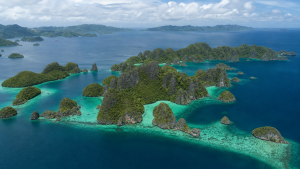
The Pacific Ocean has more islands than all other oceans combined, ranging from large continental islands to low coral atolls. These islands are commonly grouped into Melanesia, Micronesia, and Polynesia.
The Three Cultural and Geographical Regions
- Melanesia: “Black Islands”; includes New Guinea, Fiji, Solomon Islands, Vanuatu, and New Caledonia. These are mostly large volcanic or continental islands with high elevations.
- Micronesia: “Small Islands”; includes Palau, Marshall Islands, Caroline Islands, Mariana Islands, and Kiribati. These are mainly low-lying coral atolls and small volcanic islands.
- Polynesia: “Many Islands”; includes Hawaii, Samoa, Tonga, French Polynesia, Tuvalu, and Cook Islands. This region has a mix of high volcanic islands and low coral atolls.
Geological Classifications of Pacific Islands
Continental Islands
- Origin: Once connected to continents before sea-level changes or tectonic activity isolated them.
- Features: Complex rock formations, mountain ranges, and rich mineral deposits.
- Examples: New Guinea, New Caledonia, and New Zealand. New Caledonia contains about 10% of the world’s nickel reserves.
High Volcanic Islands
- Origin: Formed by underwater volcanic eruptions that build up until they rise above sea level.
- Features: Fertile soils, high elevations, and steep terrain.
- Examples: Tahiti, Hawaii, and Samoa. Mauna Kea on Hawaii is the world’s tallest mountain when measured from its underwater base.
Low Coral Atolls
- Definition: Ring-shaped coral reefs that encircle a lagoon, usually built on submerged volcanic islands.
- Features: Low elevations, thin soils, and limited freshwater sources, making them highly vulnerable to climate change.
- Examples: Marshall Islands, Tuvalu, and the Gilbert Islands of Kiribati.
Major Archipelagos in Melanesia
Papua New Guinea and Surrounding Islands
- Location: Papua New Guinea occupies the eastern half of New Guinea, the second-largest island in the world.
- Includes: The Bismarck Archipelago and the autonomous region of Bougainville.
- Highest Peak: Mt. Wilhelm.
Solomon Islands
- Structure: A double chain of volcanic islands east of New Guinea.
- Major Islands: Guadalcanal, Malaita, Choiseul, and San Cristobal.
- Nature: Volcanic in origin, covered in dense rainforests, and surrounded by extensive coral reefs.
Vanuatu
- Shape: A Y-shaped chain of about 80 islands, formerly called the New Hebrides.
- Volcanic Activity: Includes active volcanoes such as Mount Yasur on Tanna Island.
- Terrain: Mountainous, with steep cliffs and narrow coastal strips.
Fiji
- Size: An archipelago of over 330 islands and 500 islets.
- Main Islands: Viti Levu and Vanua Levu, which contain most of the population and are volcanic in origin.
- Importance: A major hub for transport, education, and regional diplomacy in the South Pacific.
New Caledonia
- Status: A special collectivity of France in the southwest Pacific.
- Components: Grande Terre, the Loyalty Islands, and several smaller islands.
- Feature: Home to the New Caledonia Barrier Reef, one of the largest double barrier reefs in the world.
Major Archipelagos in Micronesia
Caroline Islands
- Spread: A widely scattered archipelago in the western Pacific.
- Political Division: Split between the Federated States of Micronesia (FSM) in the east and Palau in the west.
- FSM States: Yap, Chuuk, Pohnpei, and Kosrae.
Mariana Islands
- Formation: A crescent-shaped archipelago formed by the summits of fifteen dormant volcanic mountains.
- Geography: Lies adjacent to the Mariana Trench, which contains the Challenger Deep, the deepest point on Earth.
- Political Division: Split into Guam and the Commonwealth of the Northern Mariana Islands (CNMI).
Marshall Islands
- Composition: 29 low-lying coral atolls and five single islands.
- Chains: The Ratak (sunrise) chain and the Ralik (sunset) chain.
- Exam Fact: Bikini Atoll and Enewetak Atoll were sites of US atmospheric nuclear testing between 1946 and 1958.
Kiribati
- Composition: 32 atolls and one raised coral island, Banaba.
- Unique Location: The only country in the world lying in all four hemispheres.
- Island Groups: Gilbert Islands, Phoenix Islands, and Line Islands. Kiritimati is the largest atoll by land area in the world.
Nauru
- Type: A single raised coral island south of the equator.
- Status: The world’s smallest independent republic and the smallest island nation.
- Economic History: Once a major exporter of high-grade phosphate, which depleted the island’s central plateau.
Major Archipelagos in Polynesia
Hawaiian Islands
- Extent: An archipelago of eight major islands and numerous smaller islets spanning 1,500 miles.
- Origin: A volcanic chain created by the movement of the Pacific Plate over the Hawaiian hotspot.
- Key Island: The Big Island of Hawaii, which has active volcanoes like Kilauea and Mauna Loa.
Samoan Islands
- Location: In the central South Pacific.
- Political Division: Samoa, an independent nation, and American Samoa, an unincorporated territory of the United States.
- Nature: Volcanic in origin and surrounded by coral reefs.
Tonga
- Size: An archipelago of 169 islands, of which 36 are inhabited.
- Status: The last remaining sovereign monarchy in the Pacific.
- Location: Stretches in a north-south line near the Tonga Trench.
French Polynesia
- Status: An overseas collectivity of France.
- Main Archipelagos: Society Islands, Tuamotu Archipelago, Gambier Islands, Marquesas Islands, and Austral Islands.
- Key Fact: Tahiti, in the Society Islands, is the most populous island. The Tuamotu Archipelago is the world’s largest chain of atolls.
Tuvalu
- Composition: Three reef islands and six true atolls.
- Elevation: Maximum elevation is only 4.6 meters above sea level.
- Vulnerability: Highly susceptible to climate-induced sea-level rise and among the smallest and most remote countries in the world.
Easter Island (Rapa Nui)
- Status: A special territory of Chile at the southeastern point of the Polynesian Triangle.
- Isolation: One of the most isolated inhabited islands in the world.
- Famous For: Nearly 900 monumental stone statues called Moai, carved by the early Rapa Nui people.
Other High-Latitude and Boundary Archipelagos
Aleutian Islands
- Composition: A chain of 14 large volcanic islands and 55 smaller ones.
- Location: Extends from the Alaska Peninsula toward the Kamchatka Peninsula, separating the Bering Sea from the Pacific.
- Political Note: The archipelago belongs to the United States, except for the Commander Islands, which belong to Russia.
Galapagos Islands
- Location: A volcanic archipelago on the equator, about 600 miles west of continental Ecuador.
- Governance: Administered by Ecuador and located on the Galapagos Triple Junction where three tectonic plates meet.
- Scientific Importance: Its isolation led to many endemic species and influenced Charles Darwin’s theory of natural selection.
Kuril Islands
- Extent: A volcanic archipelago stretching 810 miles from Hokkaido, Japan, to the Kamchatka Peninsula, Russia.
- Geographic Role: Separates the Sea of Okhotsk from the Pacific Ocean.
- Dispute: Under Russian administration, but Japan claims the southernmost islands, known in Japan as the Northern Territories.
Ryukyu Islands
- Location: A Japanese archipelago extending southwest from Kyushu to Taiwan.
- Role: Separates the East China Sea from the Philippine Sea.
- Main Island: Okinawa, the largest and most populous island in the archipelago.
Territories and External Possessions in the Pacific
- Cook Islands and Niue: Self-governing states in free association with New Zealand; their citizens hold New Zealand citizenship.
- Tokelau: A dependent territory of New Zealand consisting of three tropical coral atolls.
- Pitcairn Islands: The only British Overseas Territory in the Pacific; its tiny population is descended from the HMS Bounty mutineers.
- United States Minor Outlying Islands: Includes Baker Island, Howland Island, Jarvis Island, Johnston Atoll, Kingman Reef, Midway Atoll, Palmyra Atoll, and Wake Island. They are uninhabited except for scientific and military personnel.
- Lord Howe Island: An Australian territory featuring the world’s southernmost coral reef ecosystem.
- Norfolk Island: An external territory of Australia located in the Tasman Sea between Australia, New Zealand, and New Caledonia.
Rare Facts for Prelims
- Mauna Kea: When measured from its ocean floor base, it rises higher than Mount Everest above sea level.
- Challenger Deep: Located in the Mariana Trench, it is the deepest known point in Earth’s oceans.
- Kiritimati: Also called Christmas Island, it is one of the first places on Earth to see the new year.
- Banaba: Unlike most of Kiribati, it is a raised coral island rather than an atoll.
- Lord Howe Island: Its reef system is notable for being the southernmost true coral reef in the world.
- Rapa Nui: The Moai statues were carved from volcanic tuff, a relatively soft rock.
Current General Studies comprises current-affairs-based, General Studies-rich study material on policies, laws, institutions, economy, science, environment, governance, international relations, and other varied but important topics for UPSC and State PSC Prelims examinations.
Fortnightly PDF compilations: Available here
Originally written on
August 17, 2026
and last modified on
August 16, 2026.
| Related | |
|---|---|