Major Indigenous Defence Technologies and Systems in India
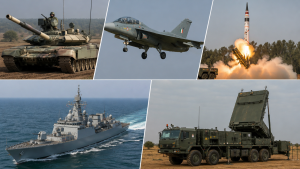
India’s indigenous defence ecosystem spans missiles, aircraft, naval platforms, radars and artillery. The Defence Research and Development Organisation (DRDO), public-sector manufacturers and private industry contribute to this effort. Defence indigenisation strengthens research and development and supports strategic autonomy by reducing dependence on foreign suppliers.
DRDO and the Integrated Guided Missile Development Programme
DRDO, established in 1958 under the Ministry of Defence, is India’s principal military research and development agency. Its network of about 50 laboratories works across fields including aeronautics, armaments, electronics, missiles and naval systems. Major programmes include the Agni and Prithvi missiles, Tejas Light Combat Aircraft and Arjun Main Battle Tank. Launched in 1983 under Dr. A.P.J. Abdul Kalam, the Integrated Guided Missile Development Programme (IGMDP) sought self-reliance in missile technology. Its five missile systems were:
- Prithvi: A short-range surface-to-surface ballistic missile, with variants for the Army, Air Force and Navy. Its stated range is 150–350 km, and it can carry conventional or nuclear warheads.
- Agni: Developed from a technology demonstrator into a series of strategic ballistic missiles. Agni variants have ranges from 750 km upwards and form a key part of India’s nuclear deterrence capability.
- Trishul: A short-range surface-to-air missile intended for quick-reaction air defence. Though discontinued, its development contributed to advances in guidance and propulsion.
- Akash: A medium-range surface-to-air missile system that can engage aerial threats at ranges of up to 45 km and altitudes of up to 20 km. It entered service with the Air Force in 2014 and the Army in 2015. A battery includes a Rajendra 3D PESA radar and four launchers.
- Nag: A third-generation, fire-and-forget anti-tank guided missile with an Imaging Infra-Red guidance system and a stated range of 500–4,000 metres. Its helicopter-launched version is called Helina or Dhruvastra.
Missile Systems Beyond IGMDP
India’s missile development has continued beyond the IGMDP, encompassing cruise, air-to-air, quasi-ballistic, hypersonic and submarine-launched systems.
- BrahMos: A supersonic cruise missile developed through a joint venture with Russia; it is among the world’s fastest supersonic cruise missiles.
- Astra: An indigenous beyond-visual-range air-to-air missile (BVRAAM).
- Pralay and Shaurya: Pralay is a conventional quasi-ballistic surface-to-surface missile, while Shaurya is a canister-launched hypersonic surface-to-surface missile.
- K-series missiles: Submarine-launched ballistic missiles that contribute to India’s nuclear triad.
Indigenous Naval Platforms and Systems
Indigenous shipbuilding and system integration have expanded the Navy’s capacity to operate aircraft carriers, submarines and advanced surface combatants.
- INS Vikrant: Commissioned in September 2022, it is India’s first indigenously designed and built aircraft carrier. The Navy’s Warship Design Bureau designed it and Cochin Shipyard Limited built it. It has about 76% indigenous content and operates an air wing of about 30 aircraft, including MiG-29K fighters and Advanced Light Helicopters.
- Submarines: The Kalvari-class Scorpene conventional diesel-electric submarines are being built in India under technology transfer. The INS Arihant class comprises India’s first indigenous nuclear-powered ballistic missile submarines (SSBNs), a component of the nuclear triad.
- Project 15B and Project 17A: Project 15B’s Visakhapatnam-class ships are stealth guided-missile destroyers; INS Visakhapatnam is the first. Project 17A’s Nilgiri-class frigates are multi-mission stealth guided-missile ships built by Mazagon Dock Shipbuilders and Garden Reach Shipbuilders & Engineers, with improved stealth and advanced indigenous weapons and sensors.
- Shakti Electronic Warfare System: Designed by DRDO’s Defence Electronics Research Laboratory, it provides protection against modern radars and anti-ship missiles. It is installed on INS Visakhapatnam and INS Vikrant.
Aeronautical, Radar and Electronic Systems
Indigenous aircraft and sensors support combat, utility and surveillance roles across the armed forces.
- LCA Tejas: An indigenous single-engine, multi-role light fighter designed by the Aeronautical Development Agency and manufactured by Hindustan Aeronautics Limited (HAL).
- ALH Dhruv and LCH Prachand: The Advanced Light Helicopter Dhruv is a multi-role utility helicopter developed by HAL. Prachand is an indigenous multi-role attack helicopter.
- Swathi Weapon Locating Radar: Developed by DRDO’s Electronics and Radar Development Establishment and Bharat Electronics Limited (BEL), this mobile counter-battery radar detects incoming artillery, mortars and rockets and identifies their origin. Its stated range for artillery is up to 50 km; it was inducted into the Army in 2008.
- Arudhra Medium Power Radar: A DRDO-designed, BEL-manufactured 4D multi-function phased-array radar for the Air Force. It provides long-range air surveillance, detecting targets up to 400 km and tracking fighter-sized targets up to 300 km.
Armoured Vehicles and Artillery
Ground-system development includes indigenous armour and long-range artillery, with public and private-sector participation.
- Arjun MBT: DRDO-developed third-generation main battle tank for the Indian Army.
- Dhanush: A 155 mm, 45-calibre towed howitzer manufactured by Advanced Weapons and Equipment India Limited. It has a stated range of 38 km and can fire NATO-compatible 155 mm ammunition; the upgraded 52-calibre version can fire up to 42 km.
- ATAGS: The Advanced Towed Artillery Gun System is a 155 mm, 52-calibre howitzer developed for the Army by DRDO’s Armament Research and Development Establishment, Tata Advanced Systems and Kalyani Strategic Systems. It features an all-electric drive and a stated range of 48 km. The Ministry of Defence signed contracts for 307 guns in March 2025.
Key Prelims Takeaways
- DRDO was established in 1958; the IGMDP was launched in 1983 under Dr. A.P.J. Abdul Kalam.
- The five IGMDP systems were Prithvi, Agni, Trishul, Akash and Nag.
- Akash is a medium-range surface-to-air missile; Nag is a third-generation fire-and-forget anti-tank missile.
- INS Vikrant is India’s first indigenously designed and built aircraft carrier, with about 76% indigenous content.
- Swathi is a weapon locating radar; Arudhra is a 4D medium-power radar for air surveillance.
- Dhanush is a 155 mm, 45-calibre towed howitzer; ATAGS is a 155 mm, 52-calibre system with an all-electric drive.
Recent Context
Solar Defence and Aerospace Limited delivered 450 Nagastra-1R loitering munitions to the Army on October 13 and 14, 2026—the largest single-batch supply of loitering munitions to the Army by a manufacturer. The emergency procurement order, worth about ₹158 crore, was placed in June 2025.
| Related | |
|---|---|