Important Types of Unmanned Aerial Systems Used in India
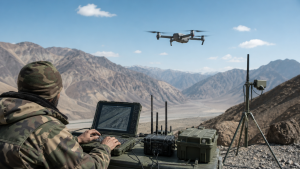
Unmanned Aerial Systems (UAS) combine an aircraft without an onboard pilot with ground control and communications systems. In India, they support military surveillance, reconnaissance, strike and logistics, as well as civilian security and disaster-response operations. Their expansion also raises questions of defence modernisation and effective regulation.
Understanding Unmanned Aerial Systems
A UAS includes an unmanned aerial vehicle (UAV), a ground-based controller and a communication system. UAVs may be remotely operated or autonomous, and range from man-portable platforms to long-endurance aircraft. Their roles include intelligence gathering, border monitoring, target designation, search and rescue, and delivery of supplies. UAS are classified by factors such as altitude, endurance, size and mission. Military platforms are used for intelligence, surveillance and reconnaissance (ISR), air-defence support, special operations, logistics and precision strikes. Civilian systems are used by security and disaster-response agencies.
Military UAS Requirements in India
The Indian Army’s technology roadmap identifies requirements across 30 types of UAS and loitering munitions. These address surveillance, air-defence support, special roles and logistics, alongside strike capabilities. The Navy uses drones for maritime surveillance, naval intelligence and support to anti-submarine warfare. The Air Force employs surveillance and combat drones for long-range reconnaissance and high-altitude monitoring. Across the services, UAS can extend surveillance and reduce the need to expose personnel to risk.
Loitering Munitions
Loitering munitions, sometimes called kamikaze drones, remain airborne over an area to locate or observe a target before striking. Unlike conventional missiles, they can allow an engagement decision to be made after launch, combining surveillance with target engagement.
- Nagastra-1R: Developed by Solar Defence and Aerospace Limited (SDAL), a subsidiary of Solar Industries India, this indigenous system is designed for short-range precision strikes. SDAL supplied 450 units to the Army on 13 and 14 October 2026. The Army’s order, worth about ₹158 crore, was placed under an emergency procurement contract in June 2025 after technical trials in March 2025.
- Nagastra-1R capabilities: It has more than 80% indigenous content and an abort-and-recovery option, allowing recall and reuse if a mission is cancelled or a target is not detected. Electric propulsion gives it a low acoustic signature; it is reported to be difficult to detect when flying above 200 metres. GPS-enabled guidance has a claimed accuracy of 2 metres. Day-and-night cameras, with an optional thermal camera, support surveillance.
- Range and payload: Nagastra-1R has an endurance of up to 60 minutes, a man-in-the-loop control range of 15 km and an autonomous operating range of 30–40 km. Its 1–1.5 kg high-explosive fragmentation warhead is intended for targets including personnel and unarmoured vehicles.
- Nagastra-1: The earlier variant, developed by Solar Industries through subsidiary Economic Explosives Limited, had 480 units supplied to the Army by December 2024. It has more than 75% indigenous content.
- Other systems: Indian Army loitering-munition systems include Johnnette JM-1, IAI Harpy, IAI Harop, Elbit Skystryker, WBE Warmate, Zulu Hoverbee and Rafael Firefly. IAI Harpy is an anti-radiation system designed to target radar installations.
Other Prominent Military UAS
- MALE UAVs: Medium-Altitude Long-Endurance systems typically operate at 10,000–30,000 feet and can remain airborne for 18–40 hours. They provide persistent ISR at medium altitudes.
- DRDO Rustom series: Developed for the three services, the series includes TAPAS BH-201, formerly Rustom-II, a MALE ISR UAV evaluated by the armed forces. Rustom-I was a technology demonstrator with 10 hours’ endurance and a maximum altitude of 20,000 feet.
- IAI Heron: The Indian Armed Forces use this Israeli MALE UAV for long-range surveillance. It can remain airborne for more than 35 hours.
- IAI Searcher II: Used by the Army, Navy and Air Force for tactical reconnaissance, it can remain airborne for 16 hours. Its stated range is 150 km at 18,500 feet, supporting missions including those over the Himalayas.
- HALE UAVs: High-Altitude Long-Endurance systems operate above 40,000 feet to provide persistent, wide-area ISR. India acquired 31 MQ-9B Sea Guardian drones from the United States in October 2024 for surveillance over land borders and maritime territories.
- Tactical surveillance UAVs: DRDO Nishant is catapult-launched and recovered by parachute; it supports reconnaissance, target designation and artillery fire correction. Panchi is its wheeled, conventional take-off-and-landing version, developed by DRDO-ADE. The small, vertical-take-off NETRA UAV, co-developed by DRDO and IdeaForge, is used by security and disaster-response agencies.
- Combat UAVs: DRDO Ghatak is a stealthy autonomous unmanned combat aerial vehicle under development. HAL CATS Warrior, developed with NewSpace Research Technologies and Tata Elxsi, is intended to work with manned fighters on strike, surveillance and electronic-warfare missions. FWD Supreme, unveiled by Flying Wedge Defence & Aerospace in October 2026, is designed for reconnaissance, electronic warfare, strikes and cooperative operations with crewed fighters.
- Long-range strike drone: IG Defence KAL is a one-way attack drone designed for deep-penetration missions against high-value targets. Publicly disclosed in March 2026 and exhibited in May 2026, it has a stated range of up to 1,000 km, a maximum take-off weight of 200 kg and a 50 kg high-explosive warhead.
Regulation and Indigenous Development
The Directorate General of Civil Aviation (DGCA) regulates civilian drone operations. The Drone Rules, 2021 replaced earlier regulations and seek to support the sector while maintaining safety and security.
- Registration: Drones other than those in the Nano category require registration on the Digital Sky Platform and a Unique Identification Number (UIN).
- Remote pilot licensing: A Remote Pilot Licence is required for commercial operation of micro or larger drones.
- Flight permissions: The “No-Permission, No-Takeoff” (NPNT) policy requires permission before flying in specified zones.
- Indigenous development: Under Aatmanirbhar Bharat, the Ministry of Defence encourages private-sector participation in drone programmes, including MALE and HALE systems. DRDO and HAL are among the agencies involved in domestic development.
Key Prelims Takeaways
- UAS components: UAV, ground control and communication system.
- Army roadmap: Covers 30 types of UAS and loitering munitions for surveillance, air defence, special roles and logistics.
- Loitering munitions: Combine aerial surveillance with the ability to engage a target.
- Nagastra: Nagastra-1R has over 80% indigenous content; Nagastra-1 has over 75%.
- Altitude classes: MALE systems operate at medium altitudes; HALE platforms provide high-altitude, wide-area ISR.
- Drone rules: The DGCA’s Drone Rules, 2021 govern civilian operations; non-Nano drones require a UIN and Digital Sky registration.
Recent Context
The October 2026 delivery of 450 Nagastra-1R units followed the supply of 480 Nagastra-1 units by December 2024. The deliveries highlight the Army’s adoption of domestically produced loitering munitions and the role of indigenous manufacturing in defence modernisation.
| Related | |
|---|---|