Major Financial Inclusion Schemes and Initiatives
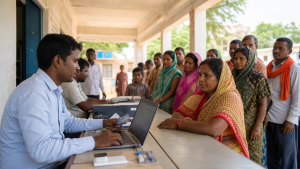
Financial inclusion is a key development strategy in India aimed at bringing households, workers, and small businesses into the formal financial system. It focuses on affordable access to banking, credit, insurance, pensions, and digital payment services, especially in underserved rural and informal sectors.
Over the years, India has built a set of large-scale inclusion schemes and supporting institutions that expand account ownership, credit access, social security, and measurable outreach. The most important schemes are PMJDY, the Jan Suraksha insurance and pension programmes, PM Mudra Yojana, and the RBI’s Financial Inclusion Index.
Pradhan Mantri Jan Dhan Yojana (PMJDY)
- Launch and purpose: PMJDY is the flagship financial inclusion programme for universal access to banking facilities, especially for unbanked adults.
- Account base: By August 28, 2026, the scheme completed 12 years and reached 59.09 crore bank accounts with total deposits of ₹3.17 lakh crore.
- Gender and location profile: Women hold about 55.7% of PMJDY accounts, while 77.8% of the accounts are in rural and semi-urban areas.
- RuPay debit cards: PMJDY account holders have been issued 41.29 crore RuPay debit cards.
- Account features: These accounts are Basic Savings Bank Deposit Accounts (BSBDAs) with zero-balance requirement, free mobile banking, and an overdraft facility of up to ₹10,000 for eligible individuals.
- Insurance linkage: The RuPay debit card includes an in-built ₹2 lakh accident insurance cover.
Social Security through Jan Suraksha Schemes
- Three schemes: The Jan Suraksha package comprises Pradhan Mantri Jeevan Jyoti Bima Yojana (PMJJBY), Pradhan Mantri Suraksha Bima Yojana (PMSBY), and Atal Pension Yojana (APY).
- Coverage focus: These schemes provide low-cost life insurance, accident insurance, and pension support to the unorganised workforce.
- PMJJBY: It offers a ₹2 lakh term life cover for death due to any cause at a premium of ₹436 per year.
- PMSBY: It provides a ₹2 lakh accident cover at a premium of ₹20 per year.
- Enrolment milestones: As of June 30, 2026, PMJJBY cumulative enrolments crossed 27.8 crore and PMSBY enrolments reached 58.8 crore.
- APY growth: APY crossed 9 crore cumulative gross enrolments on April 21, 2026, after adding over 1.35 crore subscribers in 2025–26.
- APY extension: The Union Cabinet extended APY until financial year 2030-31 on January 21, 2026.
- Age eligibility: PMJJBY applies to the 18-50 age group, PMSBY to the 18-70 age group, and APY to the 18-40 age group.
- APY benefit: APY provides a guaranteed pension after the age of 60.
Insurance Sector Reform and Bima Sakhi Initiative
- Insurance law amendment: Under the Sabka Bima Sabki Raksha (Amendment of Insurance Laws) Act, 2025, the foreign direct investment limit in insurance was raised to 100%.
- Policyholder protection: The Act also created a dedicated Policyholders’ Education and Protection Fund.
- LIC Bima Sakhi: Also called Mahila Career Agents, this initiative reached 2,86,909 active agents as of June 30, 2026.
- Rural outreach: The initiative covered more than 50% of Gram Panchayats.
Micro-Credit Delivery under PM Mudra Yojana
- Purpose: Pradhan Mantri Mudra Yojana (PMMY) supports micro-enterprises through collateral-free credit and helps generate employment at the grassroots level.
- Scale: The scheme completed 11 years on April 8, 2026, and has disbursed more than ₹40.07 lakh crore across over 57 crore accounts since launch.
- Shishu: Loans up to ₹50,000 for early-stage micro businesses.
- Kishor: Loans from ₹50,000 to ₹5 lakh for business expansion.
- Tarun: Loans from ₹5 lakh to ₹10 lakh for more advanced business needs.
- Tarun Plus: Loans from ₹10 lakh to ₹20 lakh for entrepreneurs who have successfully repaid a previous Tarun loan.
Measuring Inclusion: RBI FI-Index and Banking Reach
- FI-Index rise: The RBI’s Financial Inclusion (FI) Index rose to 70.0 in March 2026 from 43.4 in March 2017.
- Index structure: The index measures inclusion on a scale of 0 to 100 and has no base year.
- Three pillars: It uses Access (35%), Usage (45%), and Quality (20%).
- Quality component: The Quality pillar includes financial literacy, consumer protection, and grievance redressal.
- Banking outlet access: As of 2026, 99.92% of inhabited villages are covered by banking outlets within a 5-kilometre radius.
- Delivery channels: This outreach is driven largely by Business Correspondents (BCs) and brick-and-mortar branches.
Key Prelims Takeaways
- PMJDY: By August 28, 2026, it had 59.09 crore accounts, ₹3.17 lakh crore in deposits, and 41.29 crore RuPay cards.
- PMJDY profile: Women hold 55.7% of accounts, and 77.8% of accounts are in rural and semi-urban areas.
- Jan Suraksha: PMJJBY offers ₹2 lakh life cover and PMSBY offers ₹2 lakh accident cover at very low premiums.
- APY: The scheme provides a guaranteed pension after 60 and has been extended till FY 2030-31.
- PMMY: Mudra loans are grouped into Shishu, Kishor, Tarun, and Tarun Plus according to loan size and enterprise stage.
- FI-Index: RBI’s index reached 70.0 in March 2026, reflecting broader access, usage, and quality of financial services.
- Rural coverage: Nearly all inhabited villages are now within banking outlet reach of 5 km.
Current General Studies comprises current-affairs-based, General Studies-rich study material on policies, laws, institutions, economy, science, environment, governance, international relations, and other varied but important topics for UPSC and State PSC Prelims examinations.
Fortnightly PDF compilations: Available here
Originally written on
March 14, 2026
and last modified on
September 5, 2026.
| Related | |
|---|---|