Madras High Court Orders CBI Probe into University Corruption
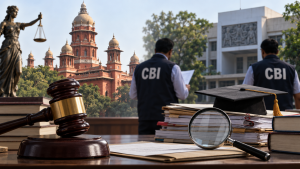
On 25 February 2026, the Madurai Bench of the Madras High Court ordered a Central Bureau of Investigation probe into corruption allegations at Madurai Kamaraj University in Tamil Nadu.
Petition and Court Observations
A Division Bench of Justices G. Jayachandran and K.K. Ramakrishnan issued the directive while hearing a public interest litigation petition filed by activist G. Venkateshan. The petition alleged illegal certificate issuance, disclosure of university documents, and bribery in research and affiliation work. Allegations also focused on staff member S.V. Gomathi, including claims of disproportionate assets and illegal activities. The Bench criticised the Directorate of Vigilance and Anti-Corruption for acting as a “post office” by forwarding the complaint to the university without proper investigation. It said corruption in universities cannot be tolerated, complaints against public servants require impartial investigation, and complainants’ identities need not be disclosed.
Important Facts for Exams
- High Court authority: High Courts and the Supreme Court may order a CBI investigation in a state without its consent, but this extraordinary power is reserved for exceptional situations.
- State consent: For investigations within states, the CBI may rely on general consent, which lasts until withdrawn, or obtain specific consent for an individual case.
- CBI Director selection: The CBI Director is selected by a committee comprising the Prime Minister, the Lok Sabha Opposition Leader, and the Chief Justice of India or a nominated Supreme Court judge.
- CBI legal foundation: The CBI was established by a 1963 Union government resolution; its investigative powers are principally exercised under the Delhi Special Police Establishment Act, 1946.
| Related | |
|---|---|