Key Concepts in Stellar and Exoplanetary Astrophysics for Prelims
Stellar and exoplanetary astrophysics focus on the origin, evolution, structural properties of stars, and the detection of planets orbiting stars beyond our Solar System. Modern observational techniques have transitioned the field from theoretical stellar modeling to direct detection of exoplanetary atmospheres, surface habitability indicators, and potential extraterrestrial biosignatures.
Core Concepts in Stellar Astrophysics
Stellar astrophysics revolves around energy generation through nuclear fusion, hydrostatic equilibrium, and evolutionary pathways dictated by initial stellar mass.
Stellar Hydrostatic Equilibrium and Energy Transport
A star maintains stability through a balance between inward gravitational collapse and outward thermal pressure generated by nuclear fusion. Energy moves from the core through a radiative zone, where photons scatter through plasma, and a convective zone, where warmer plasma rises and cooler plasma sinks.
Nuclear Fusion Cycles
Stars generate light and heat by fusing lighter elements into heavier ones in their cores.
- Proton-Proton (p-p) Chain: Dominates in low-mass stars like the Sun. Fuses hydrogen nuclei into helium at core temperatures below 15 million Kelvin.
- CNO (Carbon-Nitrogen-Oxygen) Cycle: Dominates in massive stars exceeding 1.3 solar masses. Uses carbon, nitrogen, and oxygen nuclei as catalysts to fuse hydrogen into helium at higher temperatures.
- Triple-Alpha Process: Operates in evolved red giant stars, fusing three helium nuclei into carbon at core temperatures around 100 million Kelvin.
Stellar Evolutionary Lifecycles and Limits
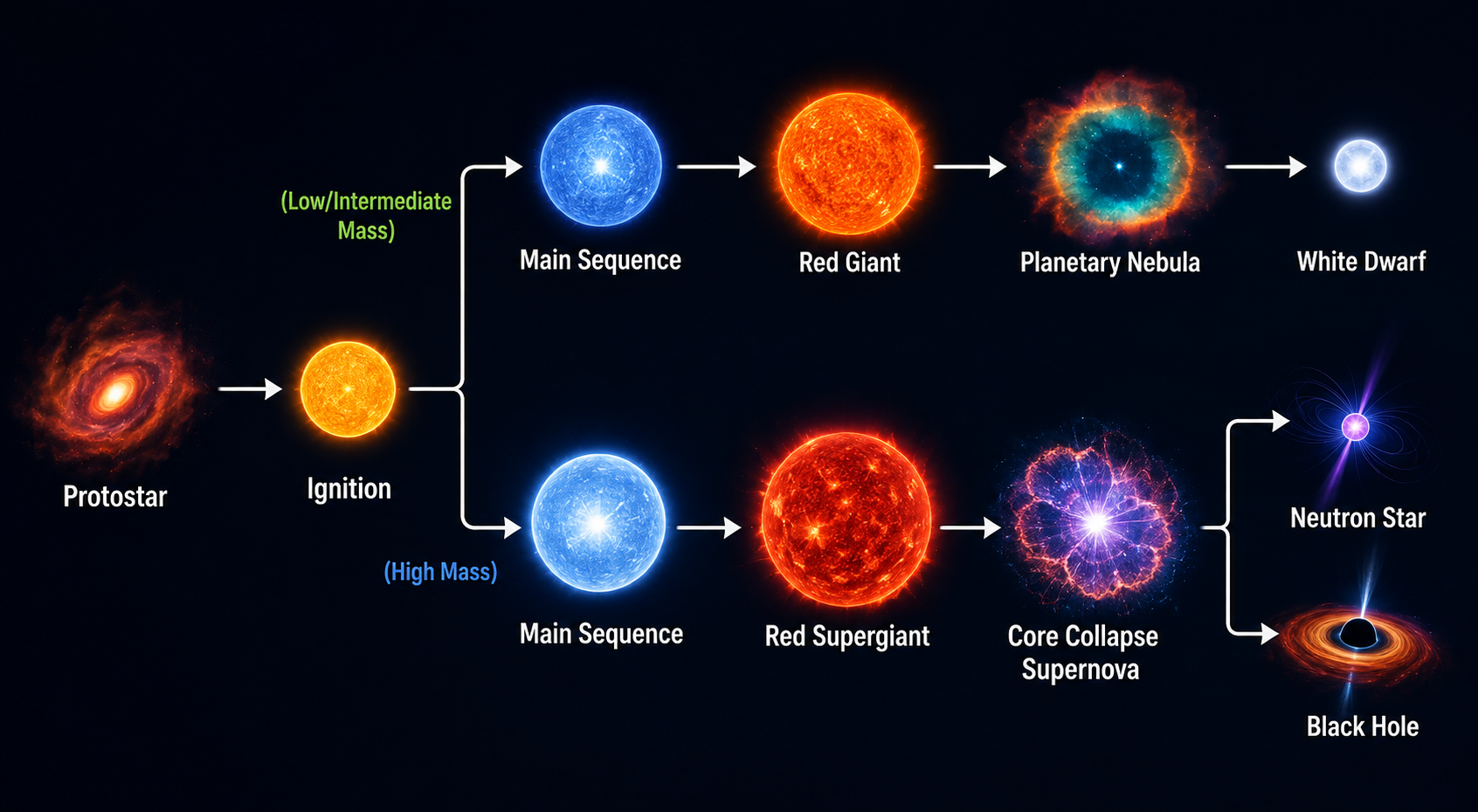
- Chandrasekhar Limit: The theoretical maximum mass limit for a stable white dwarf star, equal to roughly 1.4 solar masses (M⊙). Beyond this mass, electron degeneracy pressure fails to prevent gravitational collapse.
- Tolman-Oppenheimer-Volkoff (TOV) Limit: The mass threshold above which neutron degeneracy pressure cannot prevent a collapsing neutron star from forming a stellar-mass black hole, estimated between 2.1 and 2.3
Exoplanet Classification and Spectral Types
Exoplanets are categorized by mass, physical radius, structural composition, and orbital proximity to their host star.
Exoplanet Classes
- Hot Jupiters: Gas giant planets with masses comparable to Jupiter, but with short orbital periods (often under 10 days) due to close proximity to their parent star.
- Super-Earths: Planets with a mass greater than Earth but well below that of ice giants like Uranus and Neptune (ranging from 1 to 10 Earth masses).
- Mini-Neptunes (Sub-Neptunes): Planets smaller than Neptune, with thick hydrogen-helium atmospheres, icy cores, or deep liquid oceans.
- Hycean Worlds: A class of sub-Neptune exoplanets covered in planet-wide liquid oceans under hydrogen-rich atmospheres, studied as potential targets for habitability.
Stellar Spectral Classification (OBAFGKM)
Stars hosting exoplanets are classified by surface temperature and spectral absorption features:
| Spectral Type | Surface Temperature (K) | Dominant Colors | Solar Analogs / Stellar Examples |
| O | > 30,000 | Blue | Zeta Ophiuchi |
| B | 10,000 – 30,000 | Blue-white | Rigel, Spica |
| A | 7,500 – 10,000 | White | Sirius A, Vega |
| F | 6,000 – 7,500 | Yellow-white | Procyon A |
| G | 5,200 – 6,000 | Yellow | The Sun, Alpha Centauri A |
| K | 3,700 – 5,200 | Orange | Arcturus, Epsilon Eridani |
| M | 2,400 – 3,700 | Red | Proxima Centauri, TRAPPIST-1 |
Exoplanet Detection Methods and Planetary Science
Astronomers rely on specialized observational techniques to identify and measure exoplanet properties.
Major Detection Techniques
- Transit Photometry: Measures the periodic dimming of a star’s brightness as a planet passes directly between it and the observer. It reveals planetary radius, orbital period, and atmospheric composition through transmission spectroscopy.
- Radial Velocity (Doppler Spectroscopy): Tracks tiny periodic shifts in a star’s spectral lines caused by the gravitational tug of an orbiting planet. This method measures the planet’s minimum mass and orbital eccentricity.
- Gravitational Microlensing: Uses the gravitational field of a foreground star and its orbiting planet to magnify light from a background source star, enabling the detection of small, distant planets.
- Direct Imaging: Captures infrared light emitted or reflected by young, massive, widely separated exoplanets by blocking out stellar glare using a coronagraph or starshade.
- Astrometry: Measures small, precise shifts in a star’s physical position on the sky relative to background stars as it wobbles due to an orbiting planet.
Exoplanetary Habitability and Biosignatures
- Circumstellar Habitable Zone (Goldilocks Zone): The orbital region around a star where surface temperatures allow liquid water to exist on a planet under sufficient atmospheric pressure.
- Biosignatures: Chemical indicators in an exoplanet’s atmosphere—such as molecular oxygen (O2), ozone (O3), methane (CH4), carbon dioxide (CO2), or dimethyl sulfide (DMS)—that suggest biological activity.
Key Astronomical Missions and Observatories
Space Observatories
- Kepler / K2 Space Telescope (NASA): Discovered over 2,600 exoplanets using transit photometry, showing that planets outnumber stars in the Milky Way.
- TESS (Transiting Exoplanet Survey Satellite, NASA): An all-sky space telescope conducting transit surveys to identify exoplanets orbiting bright, nearby stars.
- James Webb Space Telescope (JWST, NASA/ESA/CSA): Infrared space observatory characterizing exoplanet atmospheric compositions and trace gases via transmission spectroscopy.
- PLATO (PLAnetary Transits and Oscillations of stars, ESA): A space mission designed to detect terrestrial exoplanets in the habitable zones of solar-type stars and study host stellar interiors.
- Habitable Worlds Observatory (HWO, NASA): A planned space telescope concept designed for direct imaging and spectroscopic analysis of Earth-like exoplanets for atmospheric biosignatures.
Ground-Based Initiatives
- E-ELT (European Extremely Large Telescope): A 39-meter optical/near-infrared telescope under construction in Chile, built to image Earth-like exoplanets and analyze their atmospheres.
- Thirty Meter Telescope (TMT): A proposed extremely large optical and infrared telescope designed for high-resolution studies of early star formation and exoplanet systems.
Key Facts for Quick Revision
- Chandrasekhar Limit: 1.4 M⊙, the upper mass bound for white dwarfs maintained by electron degeneracy pressure.
- Tolman-Oppenheimer-Volkoff (TOV) Limit: Estimated between 2.1 – 2.3 M⊙, marking the stability threshold for neutron stars before black hole collapse.
- Main Sequence Energy Source: Low-mass stars (like the Sun) convert hydrogen to helium via the proton-proton chain; high-mass stars rely primarily on the CNO cycle.
- Most Common Star Type: M-dwarfs (red dwarfs) constitute over 70% of the stars in the Milky Way and host many known small exoplanets.
- Transit Photometry Yield: Responsible for the majority of exoplanet discoveries, yielding physical size and atmospheric data.
- Radial Velocity Yield: Measures stellar wobble to establish an exoplanet’s mass and orbital parameters.
- First Exoplanet Discovery around a Main-Sequence Star: 51 Pegasi b, discovered in 1995 using the radial velocity method.
- Hycean Exoplanet Concept: Sub-Neptunes with liquid ocean surfaces beneath hydrogen-dominated atmospheres.
- Primary Biosignature Gas Pair: Simultaneous presence of significant methane (CH4) and oxygen (O2)/ozone (O3) in an atmosphere signals chemical disequilibrium, pointing to active biological replenishment.
| Related | |
|---|---|