India–Sri Lanka Bilateral Relations – Framework, Agreements, and Institutional Architecture
India and Sri Lanka share a deeply interconnected relationship shaped by geography, history, culture, and strategic maritime alignment in the Indian Ocean Region. As Sri Lanka’s closest geographical neighbor, separated only by the narrow Palk Strait, India places the island nation at the core of its “Neighbourhood First” policy and SAGAR (Security and Growth for All in the Region) vision. The institutional framework governing bilateral ties has expanded over decades from early population agreements to sophisticated economic, security, and connectivity partnerships.
Historical Accords and Treaties
Bilateral cooperation is rooted in foundational agreements signed to address demographic status, boundary definitions, and conflict resolution:
- Srima-Shastri Pact (1964): Addressed the legal status of Indian-origin Tamils working in Sri Lankan plantations. Under this accord, Ceylon agreed to grant citizenship to 300,000 individuals, while India agreed to repatriate a specified population.
- Indo-Sri Lanka Maritime Boundary Agreements (1974 & 1976): Settled maritime boundaries in the Palk Strait, Gulf of Mannar, and Bay of Bengal. The 1974 agreement recognized Sri Lanka’s sovereignty over the disputed island of Kachchatheevu.
- Indo-Sri Lanka Accord (1987): Signed by Indian Prime Minister Rajiv Gandhi and Sri Lankan President J. R. Jayewardene to resolve the Sri Lankan civil war. It led to the 13th Amendment to the Sri Lankan Constitution, creating Provincial Councils and devolving powers to Sri Lanka’s northern and eastern provinces.
Economic and Commercial Agreements
Trade and investment frameworks form the backbone of economic engagement, facilitating trade flows across South Asia.
Trade Frameworks
- India–Sri Lanka Free Trade Agreement (ISFTA): Signed in 1998 and operationalized in 2000, ISFTA was India’s first bilateral free trade agreement. It provided duty-free access to thousands of tariff lines, boosting total bilateral trade.
- Economic and Technology Cooperation Agreement (ETCA): A proposed comprehensive expansion of ISFTA designed to include trade in services, technology transfer, and investment protections.
- Local Currency Settlement Arrangement: Both nations established mechanisms enabling cross-border commercial transactions in Indian Rupees (INR) to lessen reliance on foreign currency reserves.
Key Economic Indicators
| Indicator | Details |
| Bilateral Trade Framework | India–Sri Lanka Free Trade Agreement (ISFTA, 2000) |
| Key Exports from India | Petroleum products, pharmaceuticals, automobiles, steel, textiles, machinery |
| Key Exports from Sri Lanka | Spices, apparel, tea, rubber products, animal feed |
| FDI Standing | India ranks as the second-largest Foreign Direct Investor in Sri Lanka |
| Major Investment Sectors | Telecommunications, petroleum retail, hospitality, banking, manufacturing, real estate |
Security and Defence Cooperation Mechanisms
Defence and maritime security mechanisms maintain regional stability and safeguard critical sea lanes of communication in the Indian Ocean.
Dialogue and Coordination Mechanisms
- Annual Defence Dialogue: Held between the Defence Secretaries of both countries to review overall military engagement and strategic priorities.
- Colombo Security Conclave (CSC): A regional security platform comprising India, Sri Lanka, Maldives, Mauritius, Bangladesh, and Seychelles, focused on maritime safety, counter-terrorism, cyber security, and humanitarian assistance.
Joint Military and Naval Exercises
- Mitra Shakti: An annual joint army exercise focused on counter-insurgency and counter-terrorist operations in semi-urban and rural environments.
- SLINEX (Sri Lanka–India Naval Exercise): A regular bilateral naval exercise aimed at building interoperability and maritime domain awareness.
- Dosti Exercise: A trilateral coast guard exercise involving India, Sri Lanka, and the Maldives.
Connectivity and Infrastructure Architecture
In July 2023, both nations adopted the vision document titled “Promoting Connectivity, Catalysing Prosperity: India–Sri Lanka Economic Partnership Vision”, focusing on five key connectivity pillars: 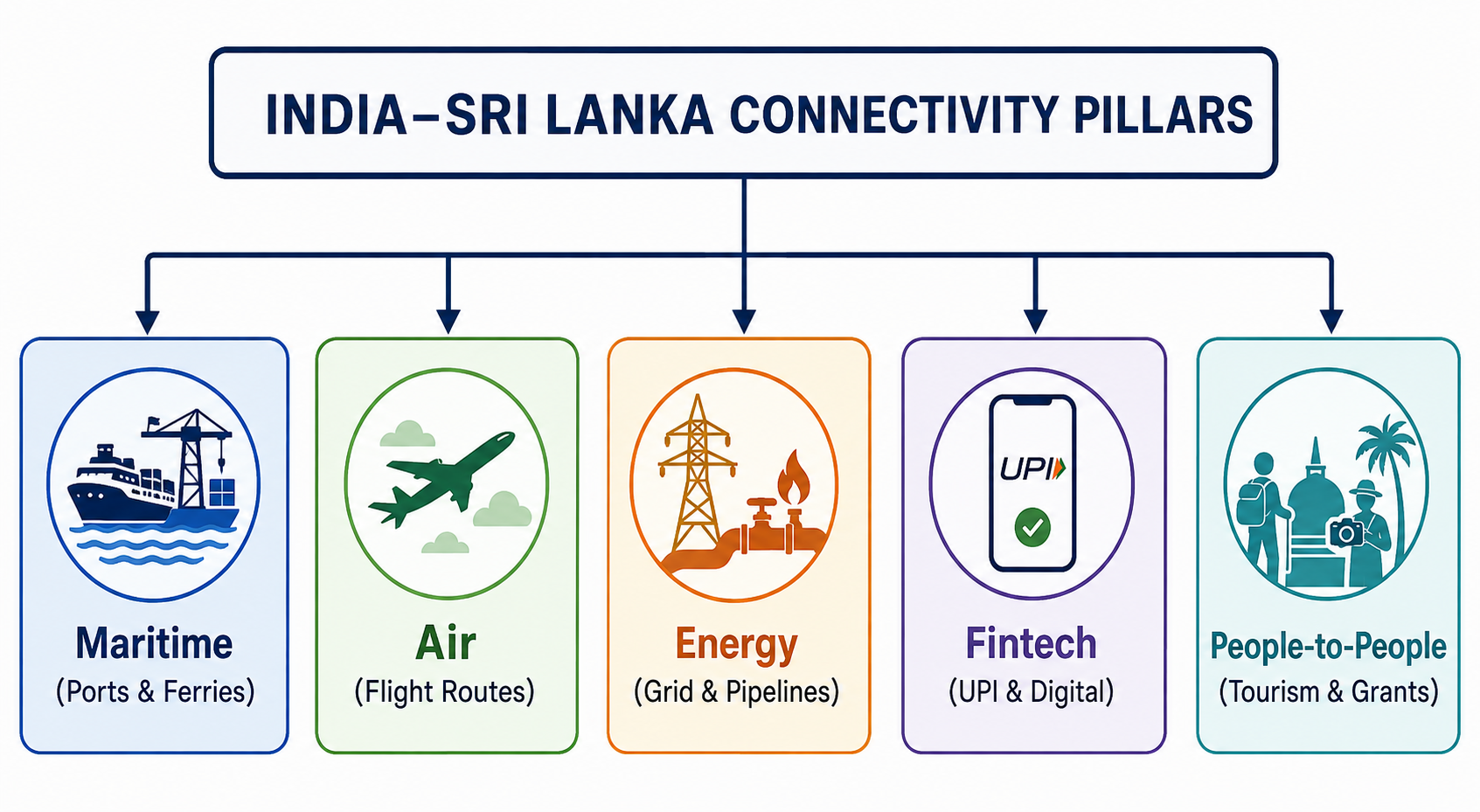
- Maritime Links: Re-operationalization of ferry services connecting Nagapattinam (Tamil Nadu) with Kankesanthurai (Jaffna). India is also aiding in the modernization of the Kankesanthurai Port.
- Energy Integration: Agreements cover high-voltage direct current (HVDC) power grid interconnection, a multi-product petroleum pipeline from Nagapattinam to Trincomalee, and joint development of the Trincomalee Oil Tank Farms.
- Renewable Projects: Joint solar power development in Sampur and wind energy projects in northern Sri Lanka.
- Fintech Alignment: Integration of the Unified Payments Interface (UPI) system in Sri Lanka to assist Indian tourists and businesses.
High-Level Institutional Mechanisms
- Joint Commission Meeting (JCM): Co-chaired by the Foreign Ministers of both countries, overseeing bilateral cooperation across trade, culture, education, and science.
- Joint Working Group (JWG) on Fisheries: Establishes regular dialogue between Fishery Ministries and Coast Guards to handle issues related to fishermen entering territorial waters.
- Inter-Governmental Technical Groups: Working committees covering civil aviation, port management, agricultural research, and tourism promotion.
Key Facts for Quick Revision
- First Bilateral Treaty: The 1964 Srima-Shastri Pact was the initial post-independence agreement handling citizenship of plantation workers.
- First FTA: India signed its first-ever Free Trade Agreement with Sri Lanka in December 1998.
- 13th Amendment Link: The 13th Amendment to the Sri Lankan Constitution stems directly from the 1987 Indo-Sri Lanka Peace Accord.
- Development Grants: Prominent Indian grant projects include the island-wide Suwa Seriya Emergency Ambulance Service, the Jaffna Cultural Centre, and the Indian Housing Project (50,000+ units).
- Strategic Hub: The Trincomalee harbour project involves joint development of 99 colonial-era oil storage tanks by Lanka IOC and Ceylon Petroleum Corporation.
- Emergency Financial Aid: During Sri Lanka’s 2022 economic crisis, India acted as the primary “First Responder,” delivering nearly USD 4 billion in currency swaps, Lines of Credit for fuel and food, and debt deferrals.
| Related | |
|---|---|