Kagan and Soai Win 2026 Nobel Prize in Chemistry
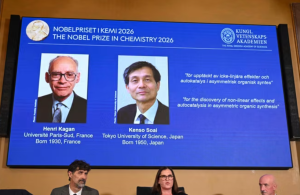
Henri B. Kagan and Kenso Soai received the 2026 Nobel Prize in Chemistry on 7 October 2026 for discoveries concerning non-linear effects and autocatalysis in asymmetric organic synthesis. The Royal Swedish Academy of Sciences announced the award in Stockholm. The prize is worth 12 million Swedish kronor, equivalent to approximately US$1.2 million.
The Nobel Prize in Chemistry
The Nobel Prize in Chemistry is one of the five original Nobel Prizes established under the will of Alfred Nobel. The Royal Swedish Academy of Sciences selects the chemistry laureates. The first Nobel Prizes were awarded in 1901. Kagan is affiliated with Université Paris-Sud in Orsay, France. Soai, aged 95 at the time of the award, is affiliated with the Tokyo University of Science. Their recognised work concerns processes used to produce chiral compounds.
Asymmetric Synthesis and Non-Linear Effects
Asymmetric synthesis is a chemical process that preferentially produces one enantiomer of a molecule over its mirror-image counterpart. Enantiomers have the same molecular formula and connectivity but differ in their three-dimensional arrangement. A non-linear effect occurs when the enantiomeric composition of a chiral catalyst does not correspond proportionally to the enantiomeric composition of the product. This relationship can affect the degree of enantiomeric excess achieved in a reaction. Enantiomeric excess measures the difference between the amounts of two enantiomers in a mixture.
Autocatalysis in Organic Chemistry
Autocatalysis occurs when a product of a chemical reaction acts as a catalyst for that same reaction. In asymmetric autocatalysis, a chiral product can promote the formation of more product with the same handedness. Kenso Soai is associated with research on asymmetric autocatalysis, including reactions in which a chiral product promotes its own formation. Such reactions are studied in organic chemistry because they combine product formation with catalytic activity. Kagan’s work on non-linear effects concerns the relationship between catalyst composition and the stereochemical outcome of asymmetric reactions.
Important Facts for Exams
- Alfred Nobel’s will established the Nobel Prizes in five fields, including chemistry.
- The Royal Swedish Academy of Sciences selects the Nobel laureates in Chemistry.
- Enantiomers are non-superimposable mirror-image forms of a molecule.
- Autocatalysis occurs when a reaction product catalyses the reaction that produces it.
The 2026 chemistry prize recognised research on non-linear effects and autocatalysis in asymmetric organic synthesis. The laureates are affiliated with Université Paris-Sud and the Tokyo University of Science.
| Related | |
|---|---|