India’s First Indigenous Insecticide Pioxaniliprole
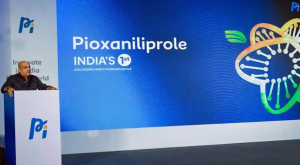
PI Industries has launched Pioxaniliprole, India’s first indigenously discovered insecticide molecule, under the trade name Pioxazon. The Central Insecticides Board and Registration Committee formally recognised it as the first insecticide active ingredient discovered in India at its 476th meeting.
Approval, formulation and crop uses
Approved as a 20% weight-by-volume Suspension Concentrate, Pioxaniliprole is registered for rice, chilli, tomato and Bengal gram (chana), and for use against fall armyworm in maize. Its target pests include yellow stem borer and leaf folder in rice; fall armyworm, fruit borer and tobacco caterpillar in chilli; fruit borer in tomato; and pod borer in Bengal gram. Commercial launches began on 31 October 2026, with a nationwide rollout from 6 November during the Rabi season.
Mode of action and development
Pioxaniliprole belongs to the anthranilic diamide class and acts on ryanodine receptors, disrupting calcium regulation in insect muscle cells. This causes paralysis, stops feeding and ultimately kills the insect. PI Industries developed the molecule after more than a decade of research and has invested about ₹2,000 crore in overall research and development since 2014. The company plans to generate data for markets including the United States, Mexico and Brazil.
Important Facts for Exams
- Chemical subclass: Pioxaniliprole is an anthranilic diamide; flubendiamide and cyhalodiamide, by contrast, are phthalic diamides.
- Pest spectrum: Diamide insecticides act mainly against lepidopteran pests, including caterpillars, a useful class-level context for Pioxaniliprole.
- IRAC group: Pioxaniliprole belongs to the diamides, which IRAC places in Group 28 in its mode-of-action classification.
| Related | |
|---|---|