Battle of El Alamein
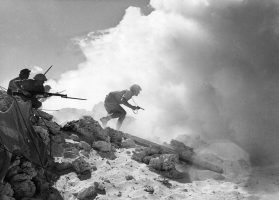
The Battles of El Alamein, fought in 1942 during the North African campaign of the Second World War, marked a decisive turning point in favour of the Allied forces. Centred around the small Egyptian railway halt of El Alamein, west of Alexandria, these engagements halted the Axis advance into Egypt and ultimately forced a major German–Italian withdrawal across Libya towards Tunisia. Together with the associated Battle of Alam el Halfa, they became emblematic of the shifting momentum of the war in the Mediterranean theatre and were later immortalised in wartime accounts, historical studies and film.
Strategic Background
By mid-1942 the Axis commander, Field Marshal Erwin Rommel, had led the German–Italian Panzer Army Africa deep into Egypt following rapid successes in Cyrenaica and at Tobruk. The British Eighth Army, retreating eastwards, made its stand along a narrow defensive line running from the Mediterranean coast at El Alamein to the impassable Qattara Depression. This geography prevented the sweeping manoeuvres that Rommel had used to such effect earlier in the desert war.
The Allies understood that the loss of Egypt, together with the Suez Canal, would have far-reaching strategic consequences. Reinforcements, reorganisation and new leadership under General Bernard Montgomery were therefore prioritised. Both sides recognised that the forthcoming battles would determine the fate of the North African campaign.
The First Battle of El Alamein (1–27 July 1942)
The First Battle of El Alamein began as Rommel attempted to push through the weakened Eighth Army towards Alexandria. His forces aimed to exploit the desert flank and break the defensive line before the British could recover. However, the combination of strong defensive positions, coordinated artillery fire and determined infantry resistance prevented an Axis breakthrough.
British, Australian, New Zealand and South African units played central roles in stabilising the front. Heavy casualties were incurred on both sides, yet the Allies successfully halted the Axis advance. With the front effectively frozen, the battle bought vital time for the reorganisation of the Eighth Army and the accumulation of fresh matériel and manpower. The failure to break the line marked the end of the Axis strategic ascendancy in the desert.
The Battle of Alam el Halfa (30 August – 5 September 1942)
Before launching a major offensive, the Allies repelled Rommel’s final attempt to turn their flank at the Battle of Alam el Halfa. Rommel sought to repeat his earlier successes by swinging around the southern end of the British line, but Montgomery anticipated the move. Tank formations were held in reserve on the Alam el Halfa ridge, creating a solid defensive position that blunted the Axis armoured thrust.
Air superiority, improved logistics and effective intelligence aided the Allies in limiting Axis movement and fuel use. Though not a large-scale engagement by the standards of the subsequent battle, Alam el Halfa ensured that the Axis retained the strategic defensive while Montgomery prepared his own offensive.
The Second Battle of El Alamein (23 October – 4 November 1942)
The Second Battle of El Alamein was one of the most significant Allied victories of the entire North African campaign. Montgomery launched Operation Lightfoot—an extensive artillery barrage designed to clear paths through the Axis minefields known as the “Devil’s Gardens”. Infantry forces advanced under cover of these barrages while engineers worked to open corridors for the armoured divisions.
The battle developed into a prolonged engagement of attrition, with fierce fighting along a broad front. Allied numerical superiority in tanks, artillery and air power gradually overwhelmed the German–Italian defences. By early November Rommel’s exhausted army could no longer hold its line, and a general withdrawal commenced. The retreat stretched across Libya, culminating months later in the Axis surrender in Tunisia in May 1943.
The victory had profound psychological and strategic impact. Winston Churchill famously reflected, “Before Alamein we never had a victory. After Alamein we never had a defeat,” encapsulating the shift in Allied fortunes that followed the triumph.
Cultural Legacy and Cinematic Representation
The dramatic nature of the desert battles, the personalities involved and the importance of the outcome ensured that El Alamein remained embedded in public memory. The engagements were later depicted in documentaries, dramatic films and wartime newsreels, collectively referred to as The Battle of El Alamein in cinematic contexts. These portrayals contributed to the wider cultural understanding of North Africa as a decisive theatre where Allied strategy, planning and resolve first turned firmly against the Axis powers.
| Related | |
|---|---|