India-Japan Deepen AI, Defence and Economic Security Ties
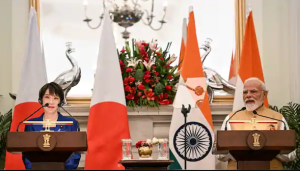
India and Japan expanded their strategic partnership at the 16th India-Japan Annual Summit in New Delhi on 2-3 July 2026. The two sides signed agreements on artificial intelligence, defence co-development, and economic security cooperation.
India-Japan Strategic Partnership
India and Japan established a Special Strategic and Global Partnership in 2014. The annual summit mechanism is used for high-level review of bilateral ties, and the 16th summit was held in New Delhi in 2026.
Japan-India AI Cooperation Initiative
The Japan-India AI Cooperation Initiative, also called JAI, was launched to build a safe, secure, trustworthy, and human-centric AI ecosystem. The initiative covers AI governance, safety, cybersecurity, digital infrastructure, semiconductors, and multilingual large language models. Artificial intelligence is a branch of computer science that enables machines to perform tasks linked with learning, reasoning, and language processing. Multilingual large language models are AI systems trained to process and generate text in multiple languages.
Defence Co-development and UNICORN System
India and Japan announced their first defence co-development project for the UNICORN communication antenna system for naval vessels. UNICORN is a communication antenna system used on warships for secure and integrated communications. Defence co-development refers to joint design or production of military equipment by two countries. India and Japan have earlier cooperated in defence dialogues, maritime security, and technology exchange.
Important Facts for Exams
- The 16th India-Japan Annual Summit was held in New Delhi on 2-3 July 2026.
- The Japan-India AI Cooperation Initiative includes AI governance, cybersecurity, semiconductors, and digital infrastructure.
- The UNICORN communication antenna system is linked with naval vessels and defence technology.
- India and Japan reaffirmed support for a free and open Indo-Pacific.
Economic Security and Trade
The Joint Declaration on Economic Security Cooperation covers resilient supply chains in semiconductors, critical minerals, ICT, clean energy, and pharmaceuticals. Economic security refers to the protection of supply chains, technology access, and strategic industries from disruption. Bilateral trade between India and Japan reached US27.5 billion in fiscal year 2025/26. Japanese investment in India totalled US3.2 billion between April and December 2025.
Investment and Human Resource Cooperation
Japan has set a target of investing 10 trillion yen in India over the next decade. The two sides also aim to double the number of Japanese companies operating in India and to bring 500 highly skilled Indian AI professionals to Japan by 2030. The fourth India-Japan 2+2 Ministerial Meeting of foreign and defence ministers is scheduled to be held in Tokyo by the end of 2026.
| Related | |
|---|---|