India and Kazakhstan Hold KAZIND-2026 Exercise
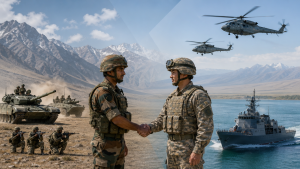
India and Kazakhstan are conducting the ninth edition of their joint military exercise, KAZIND-2026, from 28 September to 11 October 2026 in Oskemen, Kazakhstan. The exercise involves a 60-member Indian Armed Forces contingent, mainly from a battalion of the Garhwal Rifles, along with Indian Air Force personnel, and a similar-sized contingent from the Kazakhstan Armed Forces, mainly from its Land Forces.
Exercise KAZIND
KAZIND is a bilateral military exercise between India and Kazakhstan that focuses on counter-terrorism operations in a sub-conventional environment. The exercise is held under a United Nations mandate and is designed for joint training in semi-urban and mountainous terrain.
Operational Focus
The 2026 edition includes joint planning, execution, air mobility, and the integrated use of unmanned aerial systems and counter-UAS capabilities. The participating troops will conduct drills for terrorist attack response, raids, search-and-destroy missions, cordon-and-search operations, and special heliborne operations.
Validation Phase and Military Cooperation
The exercise will conclude with a validation exercise in which both contingents will apply rehearsed tactics against a simulated terrorist threat. KAZIND-2026 is the ninth edition of the exercise and forms part of India-Kazakhstan military-to-military cooperation.
Important Facts for Exams
- KAZIND-2026 is the ninth edition of the India-Kazakhstan joint military exercise.
- The exercise is being held in Oskemen, Kazakhstan, from 28 September to 11 October 2026.
- The Indian contingent has 60 personnel, including troops from the Garhwal Rifles and the Indian Air Force.
- The exercise includes counter-terrorism drills, air mobility, and the use of unmanned aerial systems.
Joint Training Themes
Counter-terrorism exercises are a regular feature of bilateral defence cooperation between armed forces that train for operations in difficult terrain and complex security conditions. KAZIND-2026 includes semi-urban and mountainous scenarios, which are common training environments in sub-conventional warfare.
| Related | |
|---|---|