Major Inland Seas and Landlocked Water Bodies
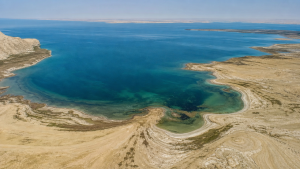
Inland seas and landlocked water bodies are large enclosed water bodies with no direct connection to the open ocean. Many are saline or brackish because water enters through rivers and leaves mainly by evaporation, causing minerals and salts to accumulate.
The Caspian Sea: The World’s Largest Inland Water Body
The Caspian Sea is the world’s largest landlocked saltwater body and has no direct connection to the world’s oceans. It lies between Europe and Asia and is bordered by five littoral states.
- Bordering Countries: Iran, Russia, Azerbaijan, Kazakhstan, and Turkmenistan.
- Hydrology: The Volga River provides about 80% of the inflow. The Ural River is another important source. The sea has no natural outlet.
- Salinity: Average salinity is about 1.2%, roughly one-third that of ocean water. The northern part is nearly fresh, while the southern part is saltier.
- Geological Origin: It is a remnant of the ancient Paratethys Sea.
The 2018 Convention on the Legal Status of the Caspian Sea was signed in Aktau, Kazakhstan, by all five littoral states.
The convention bars military forces of non-littoral states from the Caspian Sea.
As of mid-August 2026, Iran remains the only Caspian littoral state that has not fully completed ratification of the 2018 Aktau agreement.
The Tehran Convention, signed in 2003, is the main regional treaty for environmental cooperation in the Caspian basin.
The Aral Sea: A Shrinking Ecological Basin
The Aral Sea was once the fourth-largest lake in the world and is located in Central Asia.
- Location: Between Kazakhstan to the north and Uzbekistan to the south.
- Primary Inflow: The Syr Darya fed the northern section, while the Amu Darya historically fed the southern section.
- Environmental Decline: From the 1960s, Soviet irrigation projects diverted the feeding rivers for cotton cultivation, causing the sea to shrink by over 90% of its volume.
- Current Status: It split into several parts, including the North Aral Sea and the South Aral Sea. Kazakhstan built the Kokaral Dam in 2005, helping the northern part recover partially.
The Dead Sea: Earth’s Lowest Elevation and Extreme Salinity
The Dead Sea is a hypersaline lake in the Jordan Rift Valley.
- Bordering Boundaries: Jordan to the east, Israel to the southwest, and the West Bank to the west.
- Key Elevation Fact: Its shoreline is about 430 meters below sea level, making it the lowest land elevation on Earth.
- Salinity: The water is roughly 34% salt, nearly ten times saltier than typical ocean water.
- Mineral Composition: It is rich in magnesium chloride, calcium chloride, and potassium chloride.
- Primary Inflow: The Jordan River is the main source of inflow.
Other Key Landlocked Water Bodies
Lake Van (Turkey)
- Location: Eastern Anatolia region of Turkey.
- Type: The largest soda lake in the world and an endorheic saline lake.
- Key Features: Highly alkaline, with a pH of around 9.8. Its salinity is approximately 330‰, which prevents freezing despite its high altitude of 1,640 meters.
Lake Urmia (Iran)
- Location: Northwestern Iran, between East Azerbaijan and West Azerbaijan provinces.
- Characteristics: An endorheic salt lake that was once the largest lake in the Middle East.
- Ecological Threat: It has shrunk to a fraction of its historical size due to droughts, agricultural water pumping, and dams on feeder rivers such as the Zarrineh-Rud and Simineh-Rud.
Lake Titicaca (Peru and Bolivia)
- Location: On the border of Peru and Bolivia in the Andes Mountains.
- Key Record: The highest navigable lake in the world, at 3,812 meters above sea level.
- Water Characteristics: South America’s largest lake by volume. It is slightly brackish to almost fresh, fed by more than 25 rivers and glaciers. It drains partially through the Desaguadero River.
Great Salt Lake (USA)
- Location: Utah, United States.
- Characteristics: The largest saltwater lake in the Western Hemisphere and an endorheic remnant of prehistoric Lake Bonneville.
- Salinity: Varies from 5% to 27%, depending on seasonal water levels and location.
Lake Baikal (Russia)
- Location: Southern Siberia, Russia.
- Key Records: The deepest lake in the world, with a maximum depth of 1,642 meters, and the oldest lake, at about 25 million years old.
- Water Volume: Contains about 20% of the world’s unfrozen surface freshwater, making it the largest freshwater lake by volume.
Lake Chad (Africa)
- Location: Bordering Chad, Cameroon, Niger, and Nigeria.
- Environmental State: A shallow endorheic freshwater lake that has lost more than 90% of its surface area since the 1960s.
- Cause of Decline: Overuse of water resources, climate change, and weak rainfall. The Chari River provides most of its inflow.
Sea of Galilee (Israel)
- Location: Northern Israel.
- Characteristics: A freshwater lake about 215 meters below sea level, making it the lowest freshwater lake on Earth and the second-lowest lake overall after the Dead Sea.
- Key Inflow: The Jordan River flows through it from north to south.
Salton Sea (USA)
- Location: Colorado Desert of southern California.
- Origin: Formed accidentally in 1905 when an irrigation canal cut from the Colorado River broke and flooded the Salton Sink basin.
- Current Status: An endorheic, highly saline lake with no outlet. Its salinity is rising as evaporation continues and inflows from agricultural runoff decline.
Major Landlocked Water Bodies Comparison
| Water Body | Region / Countries | Key Inflows | Salinity / Water Type | Key Fact |
| Caspian Sea | Russia, Kazakhstan, Turkmenistan, Iran, Azerbaijan | Volga River, Ural River | Brackish (1.2% average) | Largest landlocked water body on Earth |
| Aral Sea | Kazakhstan, Uzbekistan | Syr Darya, Amu Darya | Hyper-saline (historically brackish) | Severe environmental drying; split into multiple basins |
| Dead Sea | Jordan, Israel, West Bank | Jordan River | Hypersaline (approx. 34%) | Lowest land elevation on Earth |
| Lake Van | Turkey | Small mountain streams | Highly alkaline / soda (pH 9.8) | Largest soda lake in the world |
| Lake Urmia | Iran | Zarrineh-Rud, Simineh-Rud | Hypersaline | Shrunk to a small fraction of its original size |
| Lake Titicaca | Peru, Bolivia | Ramis River, glacier melt | Slightly brackish / freshwater | Highest navigable lake in the world |
| Great Salt Lake | Utah, USA | Bear River, Jordan River | Variable saline (5% – 27%) | Largest saltwater lake in the Western Hemisphere |
| Lake Baikal | Russia | Selenga River, Barguzin River | Freshwater | Deepest and oldest lake on Earth |
| Lake Chad | Chad, Cameroon, Niger, Nigeria | Chari River, Logone River | Freshwater | Shrinking endorheic lake in the Sahel region |
| Sea of Galilee | Israel | Jordan River | Freshwater | Lowest freshwater lake on Earth |
| Salton Sea | California, USA | Alamo River, New River | Highly saline | Created by accidental flooding of the Colorado River in 1905 |
Recent Context
Iran approved a bill in July 2026 to ratify the 2018 Caspian Sea Convention. The move is linked to regional cooperation on navigation, fisheries, environmental protection, and security in the Caspian basin.
Rare Facts for Prelims
- Lake Baikal contains more water than all five North American Great Lakes combined.
- The Dead Sea is shrinking, and sinkholes have become a major environmental issue around its shores.
- Lake Van is so alkaline that it supports only a few specialized organisms.
- The Caspian Sea is often classified as the world’s largest lake by surface area, despite being called a sea.
- Lake Titicaca is shared by two countries and has long been important for Andean transport and settlement.
- The Salton Sea is a modern example of how irrigation mismanagement can create a large inland water body with severe salinity problems.
| Related | |
|---|---|