Important Fighter Aircraft of the Indian Air Force
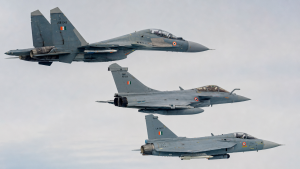
The Indian Air Force’s fighter fleet combines imported and indigenous aircraft to support air superiority, strike missions, and national air defence. After the retirement of the MiG-21 in September 2025, the force operates 29 active fighter squadrons against a sanctioned strength of 42.
Fighter Aircraft of the Indian Air Force
| Aircraft | NATO / Local Name | Origin | Generation | Primary Role | Key Weapon Integration |
| Sukhoi Su-30MKI | Flanker-H | Russia / India | 4.5 | Heavy Multirole | BrahMos-A, Astra |
| Dassault Rafale | — | France | 4.5 | Omnirole Fighter | Meteor, SCALP, HAMMER |
| HAL Tejas | LCA | India | 4 | Light Multirole | Astra, Python-5, Derby |
| Mirage 2000 | Vajra | France | 4 | Multirole Fighter | MICA, Spice 2000 |
| MiG-29 | Baaz (UPG) | Soviet Union / Russia | 4 | Air Superiority / Multirole | R-77, Kh-35 |
| SEPECAT Jaguar | Shamsher | UK / France | 3 | Deep Penetration Strike | ASRAAM, Harpoon |
| MiG-21 (Retired) | Bison | Soviet Union | 3 | Interceptor (Retired 2025) | R-73, R-77 |
Sukhoi Su-30MKI (Flanker-H)
- Origin and Manufacture: Designed by Russia’s Sukhoi bureau and manufactured in India by Hindustan Aeronautics Limited (HAL) under licence.
- Core Role: A twin-engine, long-range, heavy multirole air superiority fighter and the backbone of the combat fleet.
- Key Specifications: Features thrust-vectoring engines, canards, and the Bars passive electronically scanned array (PESA) radar.
- Weapon Systems: Carries the Astra beyond visual range (BVR) missile, Rudram anti-radiation missile, and the air-launched BrahMos supersonic cruise missile.
- Future Upgrades: The “Super Sukhoi” programme will add the indigenous Virupaksha active electronically scanned array (AESA) radar and modern avionics.
HAL has revived the Su-30MKI production line at Nashik, with 12 new aircraft planned for delivery between 2027–2028 and 2029.
Dassault Rafale
- Origin: Designed and manufactured by Dassault Aviation, France.
- Core Role: A twin-engine, canard-delta wing multirole fighter used for air defence, ground support, deep strikes, and nuclear deterrence.
- Key Specifications: Equipped with the RBE2 AESA radar, SPECTRA electronic warfare suite, and front sector optronics.
- Weapon Systems: Carries the Meteor BVR missile, SCALP cruise missile, MICA air-to-air missile, and HAMMER precision-guided munitions.
- Deployment: Operated in two squadrons at Ambala Air Force Station, Haryana (No. 17 Squadron “Golden Arrows”) and Hasimara Air Force Station, West Bengal (No. 101 Squadron “Falcons”).
HAL Tejas (Light Combat Aircraft)
- Origin: Designed by the Aeronautical Development Agency (ADA) and manufactured by HAL, India.
- Core Role: A lightweight, single-engine, multirole tactical fighter with a tailless compound-delta wing.
- Key Specifications: Powered by the General Electric F404 engine and fitted with quadruplex digital fly-by-wire controls and composite structures.
- Weapon Systems: Integrated with Astra BVR, Derby, Python-5, and precision-guided air-to-ground munitions.
Tejas Mark 1
The initial operational variant configured for air defence and close air support.
Tejas Mark 1A
The advanced variant under induction, featuring an AESA radar, self-protection jammer suite, digital map generator, and aerial refuelling probe.
Mirage 2000 (Vajra)
- Origin: Developed by Dassault Aviation, France.
- Core Role: A single-engine, multirole fourth-generation fighter.
- Operational History: Modified for laser-guided bomb delivery, it played a decisive role in the 1999 Kargil War and was also used in the 2019 Balakot airstrike with Spice 2000 bombs.
- Upgrades: Modernised to the Mirage 2000 I/TI standard with glass cockpits, advanced mission computers, and RDY-3 radar.
Mikoyan MiG-29UPG (Baaz)
- Origin: Designed by the Mikoyan bureau in the Soviet Union.
- Core Role: Originally an air superiority fighter, now upgraded into a multirole combat platform.
- Key Specifications: The MiG-29UPG standard includes the Zhuk-ME radar, improved RD-33 Series 3 engines, and expanded fuel capacity through a dorsal hump.
- Weapon Systems: Can deploy R-77 air-to-air missiles and Kh-35 anti-ship missiles.
- Maritime Variant: The Indian Navy operates the carrier-borne MiG-29K from INS Vikramaditya and INS Vikrant.
SEPECAT Jaguar (Shamsher)
- Origin: Developed by SEPECAT, a joint venture between Breguet of France and British Aircraft Corporation of the United Kingdom.
- Core Role: A twin-engine deep-penetration strike and ground-attack aircraft.
- Key Specifications: The Indian Air Force is the sole remaining operator of the platform globally, and it flies at low altitude and high speed to reduce radar detection.
- Upgrades: Upgraded to the DARIN-III standard with a modern glass cockpit, advanced navigation systems, and a multi-mode radar.
- Weapon Systems: Carries ASRAAM close combat missiles, precision-guided munitions, and Harpoon anti-ship missiles.
The Decommissioning of the MiG-21 (Bison)
- Context: Formally retired from active service on September 26, 2025.
- Historical Context: Inducted in 1963, it was the first supersonic fighter operated by the Indian Air Force. India procured more than 1,200 units over six decades.
- Operations: It saw action in the 1965 and 1971 Indo-Pakistani Wars, the 1999 Kargil War, and the 2019 border skirmish.
- Final Decommissioning: The last two operational squadrons, No. 23 (Panthers) and No. 3 (Cobras), were retired in Chandigarh, ending 62 years of service.
Future Combat Aviation Programs
To address the squadron shortfall and strengthen defence preparedness, several indigenous and joint development programmes are underway.
- Tejas Mark 2: A larger, more powerful medium-weight fighter powered by the GE F414 engine, intended to replace the Mirage 2000, MiG-29, and Jaguar fleets by the mid-2030s.
- Advanced Medium Combat Aircraft (AMCA): An indigenous fifth-generation stealth fighter programme being developed by DRDO.
- Multi-Role Fighter Aircraft (MRFA): A planned procurement of 114 advanced multirole fighters to expand the combat fleet.
Rare Facts for Prelims
- HAL Nashik’s role: Before the current revival, the Nashik division had already manufactured 222 Su-30MKI aircraft under licence.
- Contract value: The new Su-30MKI order was signed on December 12, 2024, for about ₹13,500 crore inclusive of taxes and duties.
- Indigenous content: The new Su-30MKI batch is contracted to have 62.6% indigenous content.
- Super Sukhoi plan: The proposed ₹60,000-crore upgrade is expected to be executed in two phases, with avionics and radar first, followed by advanced flight controls.
- Rafale squadrons: The IAF’s Rafales are based only at Ambala and Hasimara.
- Jaguar distinction: India remains the only air force still operating the SEPECAT Jaguar.
| Related | |
|---|---|