Important Arctic Ports, Terminals and Tanker Systems
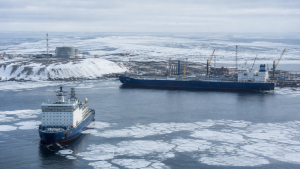
The Northern Sea Route: Geography and Navigation
The Arctic maritime system depends on a small set of deep-water ports, coastal terminals and ice-class vessels built for extreme conditions. At the centre of this network is the Northern Sea Route (NSR), which supports energy exports and links Arctic production zones to global shipping lanes.
The NSR runs entirely within the Arctic, along Russia’s northern coast from the Barents Sea to the Bering Strait. It connects the Atlantic and Pacific oceans and reduces sailing distance between Northern Europe and East Asia compared to the Suez Canal route.
- Geographic span: The NSR passes through the Barents, Kara, Laptev, East Siberian and Chukchi seas.
- Jurisdiction: It lies within Russia’s Exclusive Economic Zone (EEZ).
- Navigation conditions: Operations are affected by sub-zero temperatures, dense ice cover and polar night.
- Regulation: Shipping is governed by the Russian Northern Sea Route Administration.
- Cargo trend: Cargo transport on the route exceeded 37 million tonnes in 2025.
- Projection: Russian authorities expect annual cargo volumes to reach 70 million tonnes by 2030.
Important Arctic Ports and Coastal Terminals
Arctic ports and terminals are designed to function in ice-prone waters and serve both export and logistical needs. Some are historic ports, while others are purpose-built energy terminals linked to major oil and LNG projects.
| Port / Terminal | Location / Body of Water | Primary Function and Characteristics |
| Murmansk | Kola Peninsula, Kola Bay (Barents Sea) | Ice-free year-round due to the North Atlantic Current; handles coal, minerals and oil. |
| Sabetta | Yamal Peninsula, Ob River estuary (Kara Sea) | Deep-water port built for LNG exports from the Yamal LNG project. |
| Sever Bay (Bukhta Sever) | Taimyr Peninsula, Yenisei Gulf (Kara Sea) | Coastal export terminal for crude oil from the Vostok Oil system. |
| Pevek | Chaunskaya Bay, East Siberian Sea | Russia’s northernmost town and port; handles dry cargo and supports the Akademik Lomonosov floating nuclear plant. |
| Arkhangelsk | White Sea, mouth of the Northern Dvina River | Historic port for timber and general cargo; also a base for Arctic scientific expeditions. |
| Varandey | Pechora Sea (Barents Sea basin) | Fixed ice-resistant offshore terminal that loads oil directly onto shuttle tankers. |
The Vostok Oil Project and Pipeline Network
Vostok Oil is one of Russia’s major Arctic energy projects and is developed by the state-controlled company Rosneft. It brings together oil fields in Krasnoyarsk Krai and the Taimyr Peninsula and depends on large-scale pipeline and terminal infrastructure.
- Resource base: Rosneft estimates about 7 billion tonnes of premium low-sulfur liquid hydrocarbons.
- Core fields: The project is linked to the Vankor cluster and the Payakha group of fields.
- Export terminal: Crude is routed to the Sever Bay terminal for Arctic shipment.
- Pipeline completion: The first-stage trunk pipeline was completed on 31 August 2026.
- Pipeline length: The first stage spans about 790 kilometres.
- Engineering feature: It includes a double-stranded underwater crossing beneath the Yenisei River bed.
- Export outlook: Rosneft projects annual exports of 50 million tonnes by 2030.
Arctic Tanker Technology: Shuttle Systems and Ice Classes
Moving oil and LNG through the Arctic requires specialised vessels built to handle heavy ice, low temperatures and limited port infrastructure. Double-acting shuttle tankers and ice-class carriers are central to this system.
- Ice-class system: The Russian Maritime Register of Shipping classifies Arctic vessels by ice-strength standards.
- Arc6 and Arc7: These are high ice-class categories used for demanding Arctic operations.
- Arc6 role: Typically used for shuttle tankers transporting crude from offshore or coastal terminals.
- Rotating propulsion: Ice-class shuttle tankers often use rotating rudder propellers for manoeuvring in ice.
- Valentin Pikul: An Arc6 high-ice-class shuttle tanker built in 2024 at the Zvezda shipyard.
- Deadweight: The vessel has a carrying capacity of 69,000 tonnes and is Panamax-class.
- Ice performance: It can navigate annual ice up to 1.1 metres thick in winter-spring and up to 1.7 metres in summer-autumn.
Exam focus: The Arctic logistics chain combines ports, pipeline links and ice-class tankers. In this network, Sabetta is the LNG hub, while Sever Bay is the crude export terminal for Vostok Oil.
Environmental and Regulatory Significance
Arctic maritime logistics is not only a transport issue but also a regulatory and environmental one. Operations in this region face strict navigation rules and heightened vulnerability because ice conditions, weather and limited spill-response capacity can magnify risks.
- Shipping rules: Access and movement on the NSR are controlled by Russian Arctic navigation regulations.
- Environmental vulnerability: Arctic ecosystems are sensitive to oil spills and industrial disturbance.
- Operational dependence: Safe movement requires ice-class hulls, specialised crews and terminal support.
- Strategic value: The NSR is increasingly important for energy exports and route diversification.
Key Prelims Takeaways
- Northern Sea Route: An Arctic shipping corridor along Russia’s northern coast linking the Atlantic and Pacific oceans.
- Murmansk: The major ice-free Arctic port of Russia, active throughout the year.
- Sabetta: The key LNG export hub on the Yamal Peninsula.
- Sever Bay: The crude oil export terminal for the Vostok Oil project in Krasnoyarsk Krai.
- Vostok Oil: A Rosneft-led Arctic oil project with an estimated resource base of about 7 billion tonnes.
- Valentin Pikul: An Arc6 ice-class shuttle tanker built at Zvezda and sanctioned by the European Union on 24 April 2026.
- Traffic target: Cargo on the NSR exceeded 37 million tonnes in 2025; the 2030 target is 70 million tonnes.
Recent Context
Russia commenced the first oil flow through the Vostok Oil trunk pipeline on 5 September 2026, with crude loaded at the Sever Bay terminal. The inaugural cargo was carried by the Arc6 tanker Valentin Pikul, marking the operational launch of this Arctic export corridor.
| Related | |
|---|---|