IIT Jodhpur Joins CERN’s CMS Collaboration
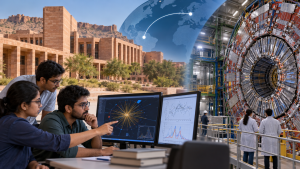
On 1 July 2026, the Indian Institute of Technology (IIT) Jodhpur became a full member of the Compact Muon Solenoid (CMS) Collaboration at CERN, near Geneva, Switzerland. The collaboration brings together universities and research institutions working at the Large Hadron Collider (LHC).
Research and collaboration
IIT Jodhpur researchers will contribute to particle physics research, next-generation detector technologies and analysis of LHC collision data using artificial intelligence and machine-learning techniques. The programme is led by faculty members Lata Panwar and Jitendra Kumar, whose previous work includes CERN’s ATLAS, ALICE and CMS collaborations. The CMS experiment is known for the discovery of the Higgs boson in 2012. Researchers associated with CERN’s LHC collaborations received the 2025 Breakthrough Prize in Fundamental Physics.
Important Facts for Exams
- Layered detector: The CMS detector places a silicon tracker inside electromagnetic and hadronic calorimeters, which measure the energies of collision products.
- Surface assembly: CMS was built above ground, lowered underground in 15 sections and then reassembled, unlike detectors assembled in situ underground.
| Related | |
|---|---|