Himachal Pradesh Signs MoU with ISB for Forest Economy
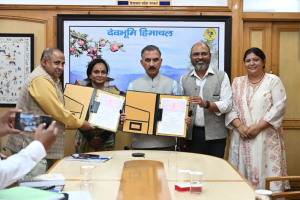
The Himachal Pradesh Forest Department and the Bharti Institute of Public Policy at the Indian School of Business signed a five-year Memorandum of Understanding in Shimla on 20 August 2026. The agreement was executed by Principal Chief Conservator of Forests Sanjay Sood and ISB-BIPP Executive Director Prof. Ashwini Chhatre in the presence of Chief Minister Sukhvinder Singh Sukhu.
Forest Economy and Natural Resource Mapping
The partnership covers forest and pastoral economy assessment in Himachal Pradesh, which has a large share of rural livelihoods linked to forests, grazing lands, and non-timber forest produce. Officials placed the untapped economic potential at ₹22,600 crore across selected bio-resources.
A joint forest inventory used more than 500 forest guards, over 2,00,000 tree-level records, species-tagged images, artificial intelligence, machine learning, and satellite data. The exercise was linked to resource mapping and valuation of forest-based products.
Counting Green Wealth Report
The partners released a joint report titled Counting Green Wealth. The report mapped seven key species: khair, bamboo, chir pine, amla, wild mango, sal, and rhododendron.
The report assigned estimated value to five major bio-resources. Amla was valued at ₹8,700 crore, pine needles at ₹5,500 crore, wild mangoes at ₹4,800 crore, sal seeds at ₹2,400 crore, and rhododendron flowers at ₹1,200 crore.
Community-Led Enterprise Models
The initiative includes community-led and sustainable enterprise models for forest produce. The women-owned Pir Panjal Jungle Producer Company in Pangi, which works with hazelnuts and thangi, was identified as a working blueprint.
Such producer companies are registered under the Companies Act, 2013, and they are used in India for collective production, processing, and marketing by primary producers.
Important Facts for Exams
- Himachal Pradesh is a Himalayan state with extensive forest cover and a large dependence on non-timber forest produce.
- Indian School of Business is a private business school with campuses in Hyderabad and Mohali.
- Artificial intelligence and machine learning are increasingly used in forest inventory, biodiversity mapping, and resource estimation.
- Non-timber forest produce includes products such as fruits, seeds, leaves, gums, resins, and medicinal plants.
| Related | |
|---|---|