Greater Flamingos Sighted at Veeranam Lake
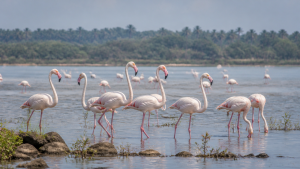
On 25 October 2026, 18 greater flamingos were sighted at Veeranam Lake in Cuddalore district, Tamil Nadu. The sighting was recorded by Professor J. Pandiyan, an associate professor and bird researcher at A.V.C. College, Mayiladuthurai, with research scholars Saravanakumar and Veerasamy. The freshwater lake lies about 50 kilometres inland, while greater flamingos are more commonly associated with coastal wetlands.
Veeranam Lake and its water supply
Veeranam Lake is a freshwater reservoir in Cuddalore district, Tamil Nadu. It is linked to the Cauvery river system through channels that convey water from the Kollidam river. The reservoir supports irrigation and forms part of the water supply infrastructure for Chennai. The 2026 sighting occurred amid reduced rainfall during the Southwest monsoon and diminished Cauvery river flows. These conditions contributed to a water deficit and dry coastal mudflats, reducing food resources in the flamingos’ usual coastal habitats.
Greater flamingo: classification and feeding
The greater flamingo (Phoenicopterus roseus) is the largest living flamingo species. It has long legs, a long neck and a specialised, down-curved bill with comb-like structures that filter food from water. Its diet includes algae, small crustaceans and other aquatic organisms. Greater flamingos use shallow wetlands, including lagoons, estuaries, salt pans and coastal mudflats. Their filter-feeding behaviour allows them to forage in shallow water and soft sediments. The receding water level at Veeranam Lake created shallow areas suitable for feeding; evaporation may also have concentrated plankton and other food resources.
Climate and wetland conditions
Researchers linked the unusual inland presence to altered rainfall patterns, a Super El Niño event and severe water deficit. They also cited reduced coastal food availability and the temporary feeding conditions at the lake as possible factors. Continued monitoring can record whether coastal birds use inland wetlands during periods of stress in their usual habitats.
Important Facts for Exams
- The greater flamingo’s scientific name is Phoenicopterus roseus.
- Flamingos feed by filtering aquatic organisms through specialised structures in their bills.
- Veeranam Lake is a freshwater reservoir in Tamil Nadu’s Cuddalore district.
- Estuaries, lagoons, salt pans and mudflats are examples of wetlands used by flamingos.
The sighting involved 18 greater flamingos at a freshwater lake about 50 kilometres inland. Researchers identified shallow-water foraging conditions and reduced food availability in coastal habitats as factors associated with the occurrence.
| Related | |
|---|---|