GOBARdhan Scheme Launched to Boost Compressed Biogas
The Union Government launched the GOBARdhan Central Sector Scheme on 1 October 2026 in New Delhi to accelerate India’s Compressed Biogas (CBG) sector. The Union Cabinet approved the GOBARdhan National Circular Bioenergy Scheme on 6 August 2026 with an outlay of ₹23,731 crore for implementation over FY 2026-27 to FY 2035-36.
GOBARdhan and Circular Bioenergy
GOBARdhan stands for Galvanising Organic Bio-Agro Resources Dhan and is linked to the broader circular economy framework in India. The scheme brings together biogas, bio-CNG, and other organic waste-to-energy initiatives under a single national platform.
The scheme integrates the Sustainable Alternative Towards Affordable Transportation (SATAT) Initiative, Market Development Assistance, and Pipeline Infrastructure Development. It is designed to create a long-term policy framework for investors, lenders, and project developers in the CBG sector.
Key Components of the Scheme
The scheme has six strategic components, including assured offtake mechanisms, a stable pricing framework, capital assistance, pipeline infrastructure development, credit guarantees, and ecosystem support funds. The pricing framework is fixed at ₹2,110 per MMBTU, or about ₹105 per kg, for a minimum period of ten years.
Eligible greenfield projects can receive capital assistance of up to ₹2 crore per tonne-per-day (TPD) of installed CBG capacity. City Gas Distribution entities will procure CBG to meet blending obligations in the CNG and PNG segments.
- The blending obligation starts at 3% in FY 2026-27.
- The blending obligation rises to 4% in FY 2027-28.
- The blending obligation becomes 5% from FY 2028-29 onwards.
Compressed Biogas in India
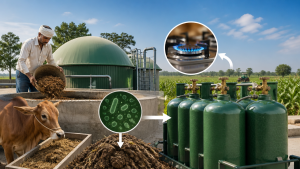
Compressed Biogas is a purified form of biogas with methane content suitable for use as a transport fuel and for injection into gas networks. It is produced from agricultural residue, cattle dung, municipal solid waste, press mud, and other organic feedstock.
As of 6 August 2026, 1,908 CBG and Bio-CNG plants were registered on the GOBARdhan Unified Registration Portal. Of these, 217 plants were commissioned and were producing 0.4 MMSCMD, while 339 plants were under construction.
Important Facts for Exams
- SATAT was launched to promote CBG as an alternative transport fuel in India.
- MMSCMD stands for Million Standard Cubic Meters per Day.
- CBG is chemically similar to natural gas after purification and compression.
- Bio-CNG is another term used for compressed biogas in fuel applications.
Economic and Environmental Targets
The scheme targets nearly ten-fold growth in domestic CBG production to around 5 MMSCMD. It is projected to generate more than ₹40,000 crore in foreign exchange savings, add over ₹75,000 crore to GDP, and create more than 1.5 lakh jobs.
The scheme is also projected to replace 10 million tonnes of fossil fuel and reduce more than 40 million tonnes of carbon dioxide emissions.
| Related | |
|---|---|