EOS-05 Completes Orbit-Raising Manoeuvres En Route to GEO
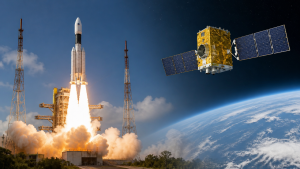
EOS-05, also designated GISAT-1A, is an Indian Earth observation satellite launched by the Indian Space Research Organisation on 4 September 2026 aboard the GSLV-F17 rocket from the Satish Dhawan Space Centre, Sriharikota. The spacecraft was placed in a sub-geosynchronous transfer orbit about 18 minutes after liftoff, and it is designed for insertion into a geosynchronous orbit at 85.5° East.
Launch Vehicle and Orbit Profile
The GSLV-F17 rocket is 51.7 metres tall and placed the 2,367 kg EOS-05 into a sub-GTO. The satellite is the heaviest payload carried by a GSLV rocket to date. A geosynchronous transfer orbit is an elliptical parking orbit used to raise a spacecraft gradually to geosynchronous altitude.
Orbit-Raising Manoeuvres
On 5 September 2026 at 8:19 PM IST, ISRO completed the first planned orbit-raising manoeuvre using the Liquid Apogee Motor, or LAM. The engine burn lasted 5,406.4 seconds, which is about 90 minutes. The manoeuvre raised the spacecraft from a perigee altitude of about 171 km to an intermediate orbit of 20,000 km by 31,129 km.
Important Facts for Exams
- EOS-05 is India’s first dedicated geosynchronous Earth-imaging satellite.
- GEO stands for geosynchronous orbit, and the standard altitude is about 35,786 km above Earth.
- The Liquid Apogee Motor is used for orbit-raising and final orbital insertion in many Indian spacecraft.
- The GSLV is a launch vehicle class used by ISRO for heavier satellites and geosynchronous missions.
Mission Features and Uses
EOS-05 has an expected operational life of 7 to 9 years. The satellite is intended for near-continuous monitoring of natural disasters, agriculture, and border areas. Earth observation satellites in geosynchronous orbit remain fixed over one region of Earth and can provide repeated imaging of the same area.
ISRO and GSLV Context
The launch was the 19th flight of the GSLV series. It was ISRO’s first successful orbital launch of 2026. The mission used a cryogenic upper stage, which is a rocket stage that stores propellants at very low temperatures.
| Related | |
|---|---|