DRDO’s Major Missile Programmes and Collaborations
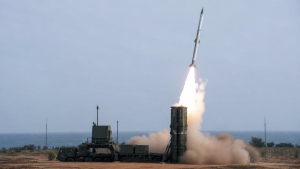
DRDO’s missile programmes cover the full spectrum of India’s air, land and maritime defence requirements. From short-range tactical weapons to strategic ballistic systems, the organisation works through indigenous design, testing and industry partnerships to strengthen operational readiness.
Project Kusha and Long-Range Air Defence
Project Kusha, formally the Extended Range Air Defence System, is India’s indigenous answer to long-range aerial threats. It is designed to create a layered air defence umbrella against hostile aircraft, drones and cruise missiles.
- Maiden test: On July 23, 2026, DRDO conducted the maiden flight-test of the Kusha long-range surface-to-air missile (LRSAM) M1 interceptor, which successfully engaged a simulated high-speed, high-altitude threat.
- Range: Project Kusha is designed to intercept aerial targets at distances up to 400 km, placing it among advanced long-range air defence systems globally.
- Interceptor variants: The system uses three missile variants for different ranges – M1 (120 to 150 km), M2 (250 km), and M3 (350 to 400 km).
- Operational role: This layered configuration gives the Indian Air Force interception capability against aircraft, drones and cruise missiles across a wide engagement envelope.
Tactical and Anti-Radiation Missile Developments
DRDO’s tactical missile portfolio includes quick-reaction, anti-radiation and short-range surface-to-air systems for immediate battlefield use. These weapons are meant to improve strike flexibility and air defence response.
- Pralay salvo test: On December 31, 2025, DRDO conducted a successful salvo launch of two indigenously developed Pralay tactical surface-to-surface missiles from a single launcher.
- Pralay profile: Pralay is a solid-propellant, quasi-ballistic missile with a range of 150 km to 500 km, a speed of up to Mach 6.1, and mid-course as well as terminal manoeuvres to evade interceptor systems.
- RudraM-II test: On June 2, 2026, DRDO and the Indian Air Force flight-tested the indigenous RudraM-II air-to-surface anti-radiation missile from a Su-30MKI fighter aircraft.
- RudraM-II capability: RudraM-II is a 300-km-class anti-radiation missile with a 200 kg warhead and terminal speed of Mach 5.5, intended for Suppression of Enemy Air Defences (SEAD) missions.
- VL-SRSAM test: On September 3, 2026, DRDO and the Indian Navy flight-tested the Vertical Launch Short Range Surface-to-Air Missile (VL-SRSAM) from Chandipur against a high-speed unmanned target.
- VL-SRSAM role: The missile has an operational range of about 80 km and an altitude ceiling of 16 km, and is meant to replace the ageing Barak-1 systems on naval vessels.
Strategic Ballistic Missiles and MIRV Progress
India’s strategic deterrence rests on the Agni series of ballistic missiles, which continue to undergo modernisation with advanced payload delivery technologies. The focus has shifted from range expansion to accuracy, survivability and multiple-target engagement.
- Advanced Agni-5 test: On May 8, 2026, DRDO successfully flight-tested an Advanced Agni-5 missile equipped with Multiple Independently Targeted Re-entry Vehicle (MIRV) technology from Dr. APJ Abdul Kalam Island.
- Significance: This was India’s second successful MIRV test.
- MIRV concept: MIRV technology allows a single ballistic missile to carry multiple warheads, each capable of striking separate targets thousands of kilometres apart.
- Agni-VI speculation: In late August 2026, India issued a 2,995-km flight corridor notification over the Indian Ocean for early September 2026, leading to analysis about a possible test of the long-range Agni-VI ballistic missile.
Industrial Partnerships and Laser Technologies
Industrial collaboration remains central to DRDO’s production base and technology integration. Public sector laboratories, private firms and joint ventures help move systems from development to manufacture and deployment.
- Laser diode stacks: The Solid State Physics Laboratory (SSPL), a DRDO facility, developed 500-watt pulsed laser diode stacks for the Quick Reaction Surface-to-Air Missile (QRSAM) and New Generation Anti-Radiation Missile (NGARM) systems.
- Prototype supply: SSPL delivered 50 prototype units of these laser diode stacks to the Instruments Research and Development Establishment (IRDE) to support optical guidance and targeting systems.
- BrahMos Aerospace revenue: BrahMos Aerospace, the India-Russia joint venture, recorded revenues exceeding ₹5,200 crore for the 2025-26 financial year, supported by domestic orders and export contracts.
- Restructuring proposal: In September 2026, the government initiated a restructuring proposal for BrahMos Aerospace to strengthen domestic R&D and separate the roles of Chairman and Director General.
Key Prelims Takeaways
- Project Kusha: India’s long-range air defence system with M1, M2 and M3 interceptor variants.
- Kusha ranges: M1 (120-150 km), M2 (250 km), M3 (350-400 km).
- Pralay: A solid-propellant, quasi-ballistic tactical missile with 150-500 km range and Mach 6.1 speed.
- RudraM-II: A 300-km-class anti-radiation missile developed for SEAD operations.
- VL-SRSAM: A naval short-range surface-to-air missile with about 80 km range and 16 km altitude ceiling.
- MIRV on Agni-5: Successfully tested on May 8, 2026, enabling one missile to engage multiple targets independently.
- Industrial role: DRDO’s missile ecosystem depends on collaboration with laboratories, public sector units, private firms and joint ventures such as BrahMos Aerospace.
| Related | |
|---|---|