Doctrine of Severability
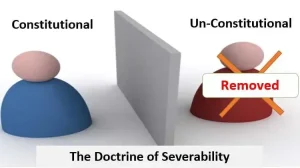
The Doctrine of Severability is a fundamental principle of constitutional and administrative law that determines the validity of legislation when part of a statute is found to be unconstitutional. According to this doctrine, if a specific provision of a law is inconsistent with the constitution but the remaining portion of the statute can operate independently and in accordance with constitutional provisions, then only the offending part is struck down, while the rest continues to remain valid and enforceable. This doctrine ensures the preservation of legislative intent to the greatest extent possible without violating constitutional supremacy.
Concept and Meaning
The Doctrine of Severability is based on the idea that a statute may contain several provisions, not all of which are necessarily invalid merely because one part conflicts with the constitution. The valid portions may be “severed” or separated from the invalid ones, allowing them to continue in force.
In essence, the doctrine maintains that the unconstitutional part of a law does not render the entire statute void, provided the remaining portion can exist and function effectively without the invalid section. This principle protects legislative efforts from complete invalidation due to partial defects.
The doctrine is also known as the Doctrine of Separability and is recognised in many constitutional systems, including those of India, the United States, and the United Kingdom, although its application varies according to judicial interpretation.
Legal Basis and Constitutional Foundation
In India, the doctrine derives its authority primarily from Article 13(1) and Article 13(2) of the Constitution of India, which state that laws inconsistent with or in derogation of the fundamental rights shall be void to the extent of such inconsistency. The phrase “to the extent of the contravention” signifies that only the offending portion is void, not the entire enactment.
Similarly, in the United States, the doctrine originates from judicial interpretation of the Constitution, particularly through the concept of judicial review, allowing courts to strike down unconstitutional portions of statutes while upholding the remainder.
Essential Conditions for Application
Courts apply the Doctrine of Severability cautiously, ensuring that legislative intent and functionality are not distorted. The following conditions generally guide its application:
- Independent Functioning: The valid part of the statute must be capable of being enforced independently of the invalid part.
- Legislative Intent: The legislature would have enacted the valid portion even without the invalid section, indicating separability.
- Coherence and Completeness: The remaining law should form a coherent, workable whole, not producing absurd or contradictory results.
- Non-alteration of Purpose: Severing the invalid provision must not change the fundamental purpose or policy of the statute.
- No Interdependence: If the valid and invalid parts are inextricably linked, such that one cannot stand without the other, the entire statute may be declared void.
Courts thus exercise judicial restraint, ensuring that partial invalidation does not lead to legislative distortion.
Judicial Interpretation and Landmark Cases in India
The Indian judiciary has elaborated the scope of this doctrine through various landmark decisions:
- R.M.D.C. v. State of Bombay (1957): The Supreme Court upheld the principle that if the valid portion of a statute can be separated from the invalid part and can operate independently, it must be maintained. The Court clarified that the decisive factor is the legislative intent and whether the remaining law can function effectively on its own.
- A.K. Gopalan v. State of Madras (1950): The Court acknowledged that unconstitutional provisions of a law affecting fundamental rights could be severed without nullifying the entire statute.
- State of Bombay v. F.N. Balsara (1951): The Bombay Prohibition Act contained certain unconstitutional provisions restricting trade. The Court held that those provisions could be struck down without invalidating the entire Act.
- Kihoto Hollohan v. Zachillhu (1992): In the context of the Tenth Schedule (anti-defection law), the Supreme Court held that only specific parts of the law violating constitutional provisions could be severed, preserving the rest of the schedule.
- Minerva Mills Ltd. v. Union of India (1980): The Court applied the doctrine to invalidate certain amendments to the Constitution that violated its basic structure while upholding other parts.
Through these cases, the Supreme Court reinforced that the Doctrine of Severability upholds constitutional supremacy while respecting the legislature’s intent.
Comparative Perspective
In the United States, the doctrine has evolved through a long line of cases. The U.S. Supreme Court often applies the “severability clause”, explicitly included in legislation to state that if any part is declared unconstitutional, the remainder shall remain valid. For example, in Alaska Airlines v. Brock (1987), the Court ruled that even without a severability clause, the valid portion may survive if it can function as intended.
In the United Kingdom, where the doctrine of parliamentary sovereignty prevails, courts traditionally lacked the power to strike down statutes. However, under the Human Rights Act 1998, courts can issue declarations of incompatibility, functionally similar to severability, allowing Parliament to decide on legislative amendment.
Importance and Objectives
The Doctrine of Severability serves multiple purposes within constitutional governance:
- Preservation of Legislative Intent: It safeguards the valid parts of a statute, ensuring that the legislature’s work is not nullified entirely due to minor unconstitutionality.
- Judicial Economy: It prevents unnecessary invalidation of entire laws, thus maintaining legal stability and continuity.
- Constitutional Supremacy: It enforces the supremacy of the constitution by invalidating provisions that contravene it.
- Protection of Rights: It ensures that unconstitutional provisions do not infringe upon citizens’ fundamental rights while preserving legitimate regulation.
- Balance of Powers: It reflects judicial respect for legislative authority while exercising constitutional oversight.
Limitations and Criticism
Despite its utility, the doctrine faces certain limitations and criticisms:
- Complex Legislative Interdependence: Many modern statutes are interlinked, making it difficult to separate invalid provisions without undermining legislative coherence.
- Judicial Overreach: Excessive use of severability may lead courts to reshape legislation, arguably encroaching on the legislative domain.
- Ambiguity in Intent: Determining whether the legislature would have enacted the valid part independently often involves speculative interpretation.
- Policy Implications: Severing key provisions may alter the policy framework or produce unintended legal consequences.
Courts thus apply the doctrine with prudence, ensuring fidelity to legislative purpose and constitutional boundaries.
Application in Constitutional Amendments
In the context of constitutional amendments, the doctrine assumes special significance. When part of an amendment violates the basic structure of the constitution, only that portion is invalidated while the rest remains effective. The Minerva Mills and Kesavananda Bharati cases established that amendments violating fundamental constitutional principles can be struck down without annulling the entire amendment, thereby reinforcing both the basic structure doctrine and severability.
Contemporary Relevance
In modern constitutional practice, the Doctrine of Severability remains crucial in maintaining the balance between legislative activity and constitutional oversight. Courts frequently rely on it in cases concerning data protection, criminal law, and digital governance, where only specific provisions may infringe constitutional rights.
Its significance continues to expand as legislation becomes more complex and intertwined with technology and fundamental freedoms. Through careful judicial interpretation, the doctrine preserves both the supremacy of the constitution and the functionality of governance, ensuring that justice, legality, and legislative efficiency coexist harmoniously.
| Related | |
|---|---|