China Launches Shenzhou-23 Three-Member Space Mission
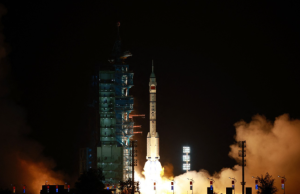
China launched the Shenzhou-23 mission on 24 May 2026 with a three-member crew aboard a Long March 2-F rocket from the Jiuquan launch centre in north-western China. The spacecraft docked with the Tiangong space station about 3.5 hours after liftoff on 25 May 2026.
Shenzhou Crew and Spaceflight Profile
The crew includes space engineer Zhu Yangzhu, former air force pilot Zhang Zhiyuan, and Lai Ka-ying, a former Hong Kong police officer. Lai Ka-ying became the first astronaut from Hong Kong to undertake a spaceflight. The mission sends three astronauts to Tiangong for scientific work and station operations.
Tiangong Space Station and Microgravity Research
Tiangong is China’s modular space station and a key platform for long-duration human spaceflight. One astronaut on Shenzhou-23 is scheduled to remain for one year to study the effects of long-duration microgravity on the human body. The mission includes experiments in life sciences, materials science, fluid physics, and medicine.
China’s Lunar Programme and Future Spacecraft
China has set a goal of landing humans on the Moon by 2030. The programme includes the Mengzhou spacecraft, which is planned for an orbital test flight in 2026 and is designed to replace the Shenzhou line for future lunar missions. China also plans the first phase of the International Lunar Research Station by 2035.
Important Facts for Exams
- Shenzhou is China’s crewed spacecraft series used for human spaceflight missions.
- Long March 2-F is a Chinese launch vehicle used for crewed missions.
- Tiangong is China’s space station and has supported long-duration astronaut stays.
- NASA’s Artemis programme is the United States’ lunar exploration programme.
International Cooperation in Human Spaceflight
China plans to welcome its first foreign astronaut from Pakistan to the Tiangong space station by the end of 2026. The International Lunar Research Station is planned as a manned scientific base in the first phase by 2035.
| Related | |
|---|---|