Chandrayaan-3 Data Reveals Three Lunar Soil Layers
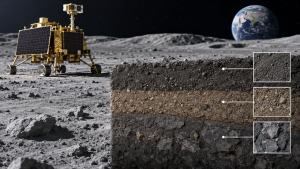
An analysis published on 17 November 2026 found three layers with distinct physical and thermal properties in the top 10 cm of lunar soil at Shiv Shakti Point, where Chandrayaan-3’s Vikram lander touched down. The study, led by K Durga Prasad of the Physical Research Laboratory, Ahmedabad, used observations from the Chandra’s Surface Thermophysical Experiment (ChaSTE).
Three-layer soil profile
ChaSTE data showed a highly porous upper layer extending to about 3 cm, with estimated porosity of 80% and bulk density of around 600 kg per cubic metre. The 3–6 cm middle layer had higher thermal conductivity. The denser layer between 6 and 10 cm had intermediate conductivity, with bulk density reaching about 1,500 kg per cubic metre at 10 cm. At local noon, the temperature gradient across the top 10 cm was about 73 kelvin, and the layers responded differently to solar heating.
Earlier measurements and the hop
The findings build on an April 2026 analysis of ChaSTE measurements that initially identified two soil layers. During Vikram’s hop manoeuvre on 3 September 2023, an engine firing disturbed the uppermost 2–3 cm of soil at the new location, exposing underlying layers for analysis. The findings were published in the Nature Portfolio journal npj Space Exploration.
Important Facts for Exams
- ChaSTE measurement scope: ChaSTE measures lunar-surface heat conductivity and temperatures at and below the surface to build a thermal profile.
- In-situ depth profile: ChaSTE’s measurements provided the first in-situ thermophysical profile within the top 10 centimetres at a high-latitude south-polar landing site.
- Heat-transfer pathways: In lunar regolith, heat moves mainly through grain-to-grain contacts and radiative exchange across pores; vacuum suppresses gas conduction and eliminates convection.
- Impact-formed agglutinates: Lunar-soil agglutinates are glassy aggregates formed when micrometeorite impacts melt and fuse mineral fragments with surrounding particles.
| Related | |
|---|---|