Cabinet Approves Semicon Mission 2.0, Mobile Manufacturing Scheme
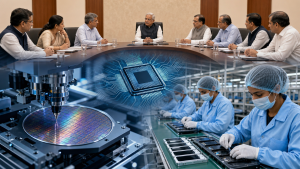
The Union Cabinet approved Semicon Mission 2.0 and the Mobile Phone Manufacturing Scheme on 15 July 2026. Semicon Mission 2.0 has an outlay of ₹1.27 lakh crore, while the Mobile Phone Manufacturing Scheme has a budgetary outlay of ₹62,500 crore.
India Semiconductor Mission
The India Semiconductor Mission was launched in 2021 as the first phase of India’s semiconductor programme. Semicon Mission 2.0 extends the programme lifecycle from 5 years to 12 years and covers six pillars of the semiconductor ecosystem.
- Chip design is one of the six pillars under Semicon Mission 2.0.
- Manufacturing of equipment and materials is included in the mission framework.
- Setting up more fabrication units, or fabs, is part of the programme.
- Advanced packaging, research and development, and talent development are also covered.
Mobile Phone Manufacturing Scheme
The Mobile Phone Manufacturing Scheme succeeds the Production Linked Incentive Scheme for Large Scale Electronics Manufacturing, also known as PLI-LSEM. The scheme will run for five years from FY2026-27 to FY2030-31.
- The scheme offers incentives of 2.25% to 5% on eligible sales.
- Additional incentives of up to 1.5% are available for domestic sourcing of components.
- Additional incentives of 3% are available for design and research and development.
- The scheme is linked to Indian brands and domestic value addition in mobile phone manufacturing.
Investment, Production and Jobs
Semicon Mission 2.0 aims to attract investments of around ₹4 lakh crore and support semiconductor production worth ₹2 lakh crore during the scheme period. The first new fab under the programme is scheduled to be commissioned by 2028. The Mobile Phone Manufacturing Scheme is expected to generate cumulative mobile phone production worth around ₹39 lakh crore and create about 60,000 direct jobs during its tenure.
Important Facts for Exams
- The combined outlay of Semicon Mission 2.0 and the Mobile Phone Manufacturing Scheme is nearly ₹1.9 trillion.
- India Semiconductor Mission 1.0 was launched in 2021.
- Three companies, Micron, Kaynes and CG Semi, had begun commercial production under Semicon 1.0 by July 2026.
- Semicon Mission 2.0 includes advanced packaging, which is a key stage in semiconductor manufacturing.
Semiconductor Ecosystem in India
Semiconductors are used in mobile phones, computers, automobiles, defence systems and industrial electronics. Fabrication units, commonly called fabs, are facilities where semiconductor chips are manufactured on silicon wafers. India’s semiconductor policy framework includes design, fabrication, packaging and ecosystem development. Mobile phone manufacturing is linked to electronics value chains, domestic sourcing and export-oriented production.
| Related | |
|---|---|