Genesis Nomad
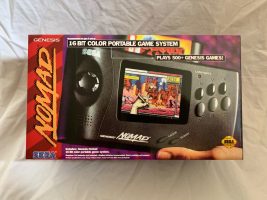
The Sega Genesis Nomad, commonly known as the Sega Nomad, is a handheld video game console manufactured by Sega and released exclusively in North America in October 1995. It represents a portable adaptation of the Sega Genesis home console, known outside North America as the Mega Drive. Designed to play full-sized Genesis cartridges, the Nomad occupies a distinctive position in video game history as the last handheld console released by Sega and the only handheld of its era capable of native television connectivity.
Released late in the lifespan of the Genesis, the Nomad had a brief commercial presence and limited long-term support. Although it offered technical parity with its home console counterpart and access to an extensive existing game library, strategic shifts within Sega and intense market competition constrained its success. Approximately one million units were sold, and it is frequently cited among notable commercial failures in the video game industry.
Background and Context
The Sega Genesis was Sega’s flagship entry into the fourth generation of video game consoles and achieved considerable success in North America during the early 1990s. By the mid-1990s, however, the market was transitioning toward next-generation hardware, with Sega investing heavily in the Sega Saturn. In the handheld sector, Sega’s earlier Game Gear faced stiff competition from Nintendo’s Game Boy, which dominated global sales due to its affordability, long battery life, and strong software support.
Against this backdrop, Sega sought to leverage the established popularity and extensive library of the Genesis by introducing a portable variant. Rather than creating a dedicated handheld ecosystem with bespoke software, Sega opted for hardware that could run existing Genesis cartridges without modification.
Development History
The conceptual roots of the Nomad lie in the Mega Jet, a portable version of the Mega Drive developed in Japan primarily for use on Japan Airlines flights. The Mega Jet required external power and a television display and was integrated into armrest monitors on aircraft. Outside this niche application, it had limited practicality and only saw a small consumer release in Japanese department stores in 1994, where it failed to achieve meaningful commercial success.
During the planning stages for a successor to the Game Gear, Sega reportedly explored the idea of a touchscreen-based handheld system, predating similar concepts later seen in competitors’ devices. However, due to the high cost and technical limitations of touchscreen technology at the time, this concept was abandoned. Instead, Sega repurposed the Mega Jet concept into a fully self-contained handheld console, internally codenamed Project Venus, which would become the Genesis Nomad.
The primary objective was to capitalise on the Genesis’s strong North American market presence. At launch, the Nomad stood out as the only handheld console capable of directly connecting to a television set, effectively functioning as both a portable and home console.
Release and Market Position
The Genesis Nomad was released in October 1995, five years into the Genesis’s market life. By this time, the Genesis library exceeded 500 titles, theoretically providing the Nomad with one of the largest launch libraries of any handheld console. Despite this advantage, the system launched without a pack-in game, which was an unusual decision for a handheld device and reduced its immediate value proposition.
According to former Sega of America executives, the Nomad was not intended to replace the Game Gear, nor was it supported by a long-term strategic roadmap. Sega was simultaneously maintaining multiple hardware platforms, including the Saturn, Genesis, Game Gear, Pico, Master System, and several add-on peripherals. In Japan, the Mega Drive had underperformed, and Sega leadership chose to prioritise the Saturn, effectively ending active support for Genesis-based products.
The Nomad also faced formidable competition from Nintendo’s Game Boy, whose market dominance was further reinforced by the release of Pokémon Red and Blue. By 1999, the Nomad was being sold at less than one-third of its original retail price.
Technical Specifications
From a hardware perspective, the Nomad is nearly identical to the standard Sega Genesis. Its central processing unit is the Motorola 68000, supported by similar memory architecture, graphics processing, and sound capabilities. This design choice ensured near-perfect compatibility with Genesis cartridges.
The console features a 3.25-inch backlit colour liquid-crystal display, a significant advancement over the non-backlit screen of the Game Gear. An integrated audiovisual output port allows the Nomad to be connected to a television, enabling gameplay identical to that of a home console.
In terms of physical design, the Nomad incorporates several elements reminiscent of the Game Gear while adding a six-button control layout to ensure compatibility with later Genesis titles. Additional features include:
- A mono speaker
- A headphone jack with volume control
- A red power switch
- A dedicated controller port for multiplayer games
The controller port functions exclusively as a second-player input, meaning single-player games cannot be controlled using an external Genesis controller.
Power options include an AC adapter, a rechargeable battery pack known as the Genesis Nomad PowerBack, or six AA batteries. Battery life is limited, typically ranging from two to three hours, which was widely criticised at the time of release.
Peripheral Compatibility
The Nomad is compatible with several Genesis peripherals, including the Sega Activator, Team Player adaptor, Mega Mouse, and network services such as Sega Channel and XBAND. However, it is incompatible with several major Genesis add-ons, most notably the Power Base Converter, Sega CD, and 32X.
As a result, the Nomad is restricted to playing standard Genesis cartridges, whereas a full Genesis setup can also support Master System, Sega CD, and 32X games through additional hardware.
Game Library and Software Support
The Nomad does not possess a dedicated software library of its own. Instead, it relies entirely on the existing Genesis catalogue, which numbered over 500 games at the time of its release. While this provided substantial variety, the absence of exclusive titles or a pack-in game limited its appeal to consumers unfamiliar with the Genesis ecosystem.
The system is capable of running unlicensed homebrew and bootleg Genesis games. Some early third-party titles experience compatibility issues on the Nomad, although these can often be resolved using devices such as the Game Genie. Due to hardware limitations and add-on incompatibility, the Nomad cannot play Master System, Sega CD, or 32X software.
The console employs both physical and software-based regional lockout mechanisms, though methods to bypass these restrictions have since been identified by enthusiasts.
Reception and Legacy
Critical reception of the Genesis Nomad was mixed. Contemporary reviews praised its technical achievement and full compatibility with the Genesis library, often describing it as the most powerful handheld system available at the time. However, criticism was consistently directed at its high price, short battery life, and the small size of its display, which made certain fast-paced or visually dense games difficult to play.
Some reviewers noted motion blur on the screen during fast scrolling sequences, detracting from the gameplay experience. Retrospective assessments have highlighted poor market timing, inadequate advertising, and Sega’s divided corporate focus as key factors behind its commercial failure.
| Related | |
|---|---|